Save 15% on your 1st Autoship learn more

 Email us
 Live Chat
 FAQs
FAQs





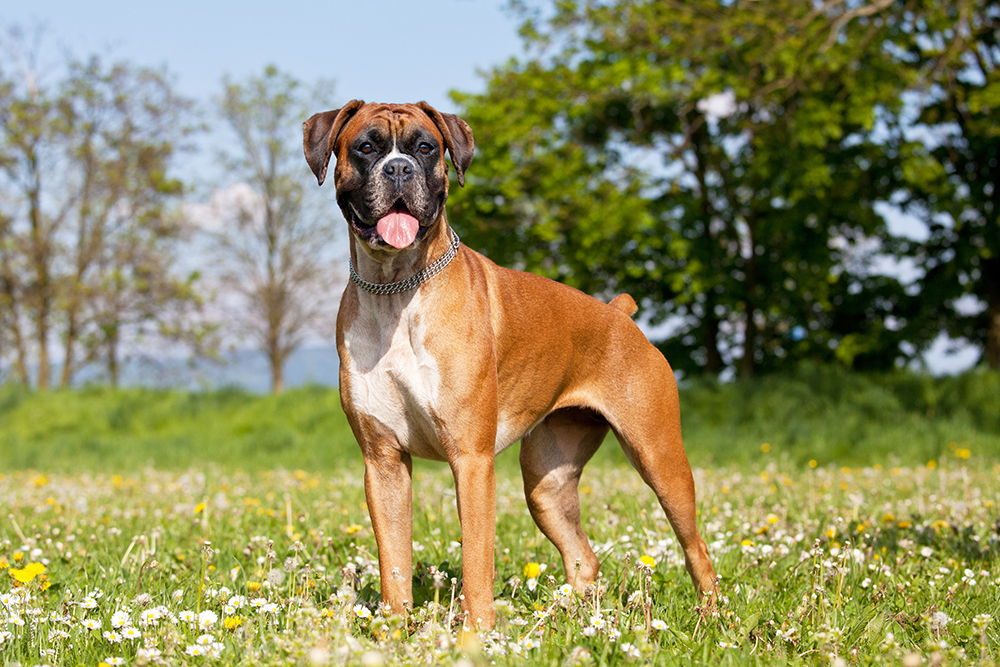
With their large, muscular bodies and severely jutting lower jaws, boxers can look intimidating. However, their fierce outer appearance belies a gentle, fun-loving demeanor. Boxers are canine clowns that keep people laughing with their playful antics. At the same time, they are devoted watchdogs that take their responsibility to keep their people safe very seriously. Get to know more about this breed to find out if a boxer might make a good pet for your family.
History
The boxer descended from the Bullenbeisser, a now-extinct breed of German mastiff. "Bullenbeisser" translates to "bull-biter," and these dogs were bred to hold onto large, powerful game animals, such as bulls, boars, bears, and deer, until the hunters could catch up with them. A strong, jutting lower jawbone could be very helpful in this regard.
Early specimens of the boxer breed were interbred with English bulldogs in the late 19th century. The boxer was officially recognized as a distinct breed in 1904. It was first introduced in the United States after World War I and has consistently remained one of the most popular breeds in the nation ever since.
Boxers get their name from an ability to rise up on their hind legs and make a motion with their front paws as though they are sparring. They may do this in play, either with other dogs or with human family members, but they can also do it in self-defense.
Appearance
The boxer is a medium-to-large dog breed. Males can weigh up to 80 pounds and measure up to 25 inches at the shoulder. Female boxers are slightly smaller, weighing about 15 pounds less than males on average.
Boxers are brachycephalic, meaning that their snout is shorter than average, with a jutting lower jaw that gives them a pronounced underbite. They have large brown, slightly bulging eyes. Boxers have a furrowed brow that gives their faces a wide range of expression.
Boxers have compact, muscular bodies with a lean, athletic build. Standard coat colors are fawn, which is a brown or tan color, and brindle, which is brown or gray with swirling black stripes. White spots on the chest and feet are an acceptable part of the breed standard. All-white boxers are possible, but this coat variation is associated with deafness and therefore discouraged. White boxers can be registered with the American Kennel Club if altered so they can no longer breed.
When boxers were primarily hunting dogs, it was customary to dock (surgically shorten) their tails and crop their ears. This was a safety measure to prevent large animals from getting ahold of these portions of their anatomy and injuring them. However, the practices of docking tails and cropping ears have become controversial, especially since boxers are no longer used primarily for hunting. The American Kennel Club allows docking and cropping but no longer requires it as part of the breed standard. Since many veterinary organizations and animal welfare groups have spoken out against the practice, it is becoming increasingly more common to see boxers with their naturally floppy ears intact.
Personality
Most dogs prefer to spend time among humans, but for boxers, it is a necessity. Though they make good watchdogs, boxers should not be kept primarily outside. They should spend most of their time inside interacting with their family. Boxers can also experience problems if they need to be left alone for most of the day.
Boxers are intelligent, high-energy dogs. They need physical and mental stimulation so they don't get bored. They have high needs for exercise, meaning long walks on a leash or plenty of time spent running around in a fenced-in yard, preferably playing fetch with you.
Health and Grooming
Like most dog breeds, boxers have some health problems that tend to afflict them. One of these is a heart condition called boxer cardiomyopathy. Before adopting a boxer, it is recommended that you have health tests done on the cardiovascular system as well as the elbows, hips, and thyroid gland to detect any abnormalities. Brachycephalic dogs such as boxers can experience breathing problems because of their short muzzles. Boxers are also at increased risk of developing cancer.
Boxers have short, smooth coats that are fairly easy to keep clean and well-groomed. They can be brushed once or twice a week using a curry brush. Boxers don't need frequent baths, but you should keep their face wrinkles clean to prevent infection. Like other dog breeds, boxers should have their teeth brushed several times a week, if not daily, and their nails should be trimmed on a monthly basis.
Training and Family Life
Boxers need training from an early age so that you can control their behavior when they grow large. Because they are both intelligent and eager to please, they tend to be very receptive to training. However, they don't respond well to harsh training methods and are likely to become very stubborn. You are likely to see better results if you use toys and treats to make training fun for your boxer.
Boxers are known for being gentle and patient with young children, making them good family dogs. Nevertheless, children and dogs should always be supervised when playing with one another. Even a gentle dog can bite under certain circumstances, and a large, powerful dog like a boxer doesn't always know its own strength and can accidentally knock a small child over.
Boxers are devoted to their families and very protective of them. They may view newcomers with suspicion at first but tend to be very intuitive at distinguishing friend from foe.