
 Save 15% on your 1st Autoship learn more

 Email us
 Live Chat
 FAQs
FAQs





Introduction
You might be standing in your bathroom, finishing up your own morning routine, when you look down at your dog and notice a few tangles or a loose patch of fur. It is incredibly tempting to reach for your own hairbrush to give them a quick once-over. At BaxterBoo, we hear this question from well-meaning pet parents quite often. While it seems like a convenient shortcut, your own brush is designed for human scalp health and hair density, which is fundamentally different from a dog’s coat. Using the wrong tool can lead to skin irritation, ineffective grooming, or even painful snags. This article covers why specialized tools matter, how to identify your dog’s specific coat needs, and the best ways to keep their skin healthy. We want to help you turn grooming from a chore into a comfortable bonding ritual for your pup.
Quick Answer: While you can technically use a human brush on a dog in an emergency, it is not recommended for regular use. Human brushes lack the specialized pin angles and spacing needed to penetrate a dog's dense undercoat or safely remove mats without causing skin irritation.
The Mechanics: Human Hair vs. Canine Fur
To understand why a regular brush fails, you have to look at the anatomy of hair. Human hair generally grows as a single strand from each follicle. Our brushes are built to glide over the scalp and through these relatively thin strands. Most dogs have a much more complex coat structure. Many breeds are "double-coated," meaning they have a stiff outer layer of guard hairs and a dense, soft undercoat for insulation.
A standard human paddle brush or round brush typically has plastic bristles with small balls on the tips. These balls are great for a human scalp, but they are a nightmare for dog fur. They tend to catch on the thick undercoat and pull on the skin rather than sliding through. This causes a sensation similar to having your hair pulled in a tight ponytail, which can make your dog learn to hate grooming sessions.
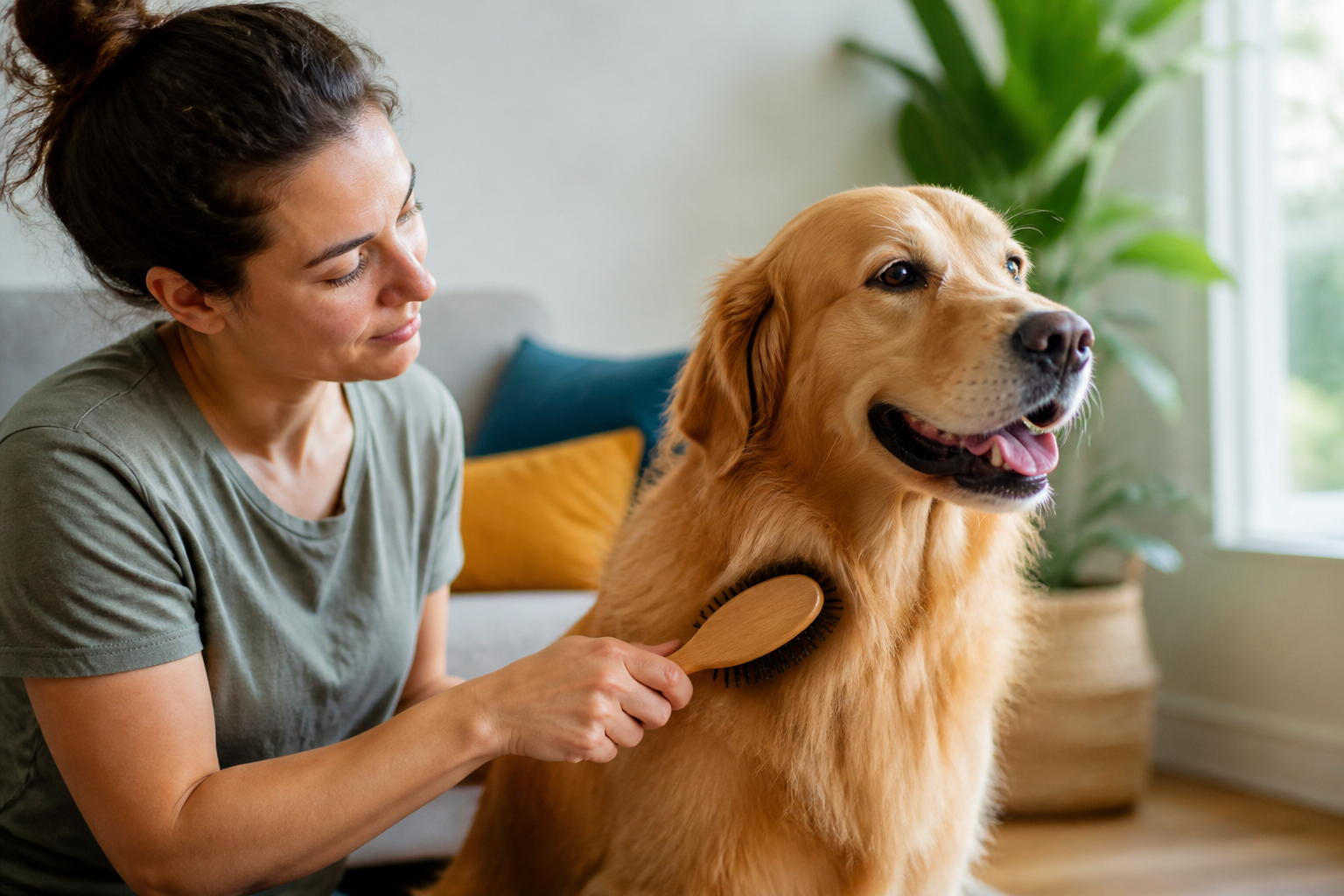
The density of the hair is the second major factor. A human brush is simply not designed to reach the skin through three inches of dense Golden Retriever fur. It only skims the surface. This creates a false sense of security where the top looks shiny, but painful mats are forming right against the skin.
The Risks of Using a Regular Human Brush
Using a regular brush on your dog carries several real risks. The most common issue is "brush burn." This happens when you have to press down too hard or go over the same spot repeatedly because the human brush isn't doing the job. The result is red, inflamed skin that can eventually lead to hot spots or infections.
Human brushes also fail to remove the "dead" hair that accumulates in the undercoat. When this hair isn't removed, it stays trapped against the body. It mixes with natural oils and moisture to form thick, felt-like mats. These mats are not just an aesthetic issue. They pull the skin tight, which causes constant discomfort and can even restrict the dog’s movement.
Key Takeaway: Using human grooming tools on pets often leads to "surface-only" brushing. This hides deep matting and increases the risk of skin irritation because the tool is not matched to the coat's density.
Identifying Your Dog’s Coat Type
Before you pick out a new tool, you need to know exactly what you are working with. Not every dog needs a heavy-duty rake. Some only require a light touch.
Smooth and Short Coats
Breeds like Boxers, Great Danes, and Dalmatians have smooth coats. These are the easiest to maintain, but they still shed. For these dogs, a human brush is often too harsh. The stiff plastic bristles can scratch their sensitive skin because there is very little fur to act as a buffer.
Double Coats
This category includes Labrador Retrievers, German Shepherds, and Huskies. These dogs have a "blow out" season twice a year where they lose massive amounts of undercoat. A human brush is completely useless during these times. You need tools that can reach through the guard hair to grab the loose fluff underneath.
Curly and Wavy Coats
Poodles and Doodles fall into this group. Their hair doesn't fall out; it gets trapped in the curls. This is the highest-maintenance coat type. If you use a regular brush here, you will likely just create a frizzy mess while leaving the tangles near the skin untouched.
Wire and Silky Coats
Wire-haired breeds like Schnauzers have a rough texture that needs a firm hand. Silky-coated dogs like Yorkies have hair that is the most similar to human hair, but it is much finer and tangles much more easily. Even for these breeds, a specialized pin brush is safer than a drugstore human brush.
The Ultimate Dog Brush Guide
If you want to do the job right, you should have a few specific tools in your kit. We carry a wide variety of these at BaxterBoo to ensure every pet owner has access to professional-grade equipment. Explore our dog brushes and combs collection to compare options for different coat types.
The Slicker Brush
This is the workhorse of dog grooming. It has a flat or slightly curved head with rows of thin, angled wire pins. These pins are designed to grab loose hair and break up small tangles without scraping the skin. It is the best choice for medium-to-long hair and curly coats. A product such as the Master Grooming Tools Ergonomic Slicker Dog and Cat Brush is designed for brush-outs and mat removal.
The Undercoat Rake
If you have a heavy shedder, a rake is non-negotiable. It looks like a small gardening tool with long, metal tines. It reaches deep into the undercoat to pull out dead hair before it ends up on your sofa. When using a rake, you must be gentle. Use short, light strokes. The Master Grooming Tools Ergonomic Undercoat Rakes are made for removing loose undercoat hair.
The Bristle Brush
For smooth-coated dogs, a soft bristle brush is perfect. It removes surface dust and distributes natural oils across the skin. This keeps the coat shiny and healthy without any risk of irritation.
The Rubber Curry Brush
This is a fantastic tool for short-haired dogs or for use during bath time. The rubber nubs massage the skin and stimulate blood flow. Brands like Kong make excellent rubber brushes that dogs actually enjoy because they feel like a massage. You can also browse our selection of BASS Brushes for bathing and brushing options.
Vet Tip: If your dog's skin appears red, bumpy, or has a strange odor during grooming, consult your veterinarian. These can be signs of allergies or fungal infections that require professional diagnosis. Our pet pharmacy, in partnership with Pet's Choice, can help fulfill prescriptions for medicated shampoos or skin treatments once your vet provides a plan.
How to Properly Brush Your Dog: A Step-by-Step Process
Grooming should be a methodical process. Rushing through it is how accidents and skin scrapes happen. Follow these steps to ensure a safe and effective session.
Step 1: Choose the right environment. / Find a quiet area with good lighting where your dog feels secure. If you have a small dog, using a sturdy table can save your back and keep them from wigging out.
Step 2: Perform a quick "hand check." / Run your hands all over your dog’s body. Feel for any new lumps, bumps, or large mats that you might have missed visually. This helps you avoid hitting a sensitive spot with the brush.
Step 3: Start from the bottom. / Most people start at the head, but starting at the legs and moving upward is often more comfortable for the dog. It allows you to clear tangles from the extremities before moving to the larger surface areas of the body.
Step 4: Use the "line brushing" technique. / For long or double coats, push the hair up with one hand and brush the hair underneath. This ensures you are reaching the skin and not just the top layer.
Step 5: Follow up with a metal comb. / Once you think you are finished, run a metal "Greyhound" comb through the coat. If the comb snags, you still have a tangle that needs attention. A fine-tooth option such as the JW GripSoft Flea & Fine Dog Comb can help with detailed combing.
When Grooming Reveals Health Issues
Regular grooming is your first line of defense against health problems. As you brush, you are in a prime position to spot fleas, ticks, or skin abnormalities. If your dog is constantly itchy or has "yeasty" smelling ears, the issue might be deeper than just a dirty coat. For additional bath and brushing guidance, read our tips for bathing your dog.
Chronic skin issues often require more than just a good brush. Many dogs suffer from environmental or food allergies that manifest as skin irritation. This is where our pharmacy becomes a vital resource for your pet's care. Through our partnership with Pet's Choice, we offer FDA-approved medications and prescription diets. If your vet determines your dog needs a specialized diet like Farmina Vet Life for skin sensitivities or a prescription-strength flea preventive, you can easily manage those needs through us.
Key Takeaway: Proper grooming tools allow you to monitor skin health closely. This makes it easier to catch issues early and coordinate with your vet for any necessary pharmacy treatments or prescription diets.
Training Your Dog for Grooming Success
Not every dog is born loving the brush. In fact, many are quite suspicious of it. The goal is to build a positive association so that they stand still and relax.
- Introduce the tool slowly: Let your dog sniff the brush while it is sitting on the floor. Give them a high-value treat just for being near it.
- Keep sessions short: Start with just thirty seconds of brushing. Stop before your dog gets restless.
- Reward throughout: Feed small treats like those from Greenies or Stella and Chewy's while you brush. This teaches them that "brushing equals snacks."
- Watch for stress signals: If your dog is excessively panting, yawning, or trying to hide, stop the session. Forcing it will only make the next time harder.
For dogs with extreme anxiety during grooming, you might want to look into calming supplements. Products from brands like Zesty Paws or Honest Paws can help take the edge off and make the training process smoother.
Bottom line: A specialized dog brush is a small investment that prevents skin damage, reduces shedding, and makes the grooming experience much more pleasant for your dog.
Conclusion
While a regular human brush might look like it's doing the job on the surface, it isn't designed for the complex needs of canine fur. Investing in a proper slicker brush, rake, or bristle brush protects your dog from brush burn and painful matting. It also makes your job as a pet parent much easier. Remember that grooming is more than just about looks; it is a vital health check. If you find something concerning during your routine, always check with your vet. We are here to support that journey with everything from the right grooming gear to prescription support through our pharmacy.
Ready to upgrade your grooming kit? Check out our full collection of grooming supplies to find the perfect match for your dog's coat type. You can even set up our Autoship programme for your favorite grooming wipes and shampoos to save time and money.
FAQ
Can I use a human hairbrush on a short-haired dog?
Even on short-haired dogs, human brushes are usually too stiff and can scratch the skin. A soft bristle brush or a rubber curry brush is much safer and more effective at removing loose fur and dirt. These tools are specifically designed to be gentle on the skin while still stimulating healthy oil production.
Will a human brush help with my dog's shedding?
No, a human brush is generally ineffective for shedding because it cannot reach the undercoat where most shed hair originates. You need a deshedding tool or an undercoat rake to properly remove the dead hair. Using a human brush will likely just move the hair around on the surface without actually removing it.
Is it okay to use a comb meant for humans on a dog?
Most human combs are made of plastic, which can create static and snap easily when hitting a dog's mat. Professional dog combs are usually made of stainless steel with rounded tips to protect the skin. The metal tines are much stronger and can glide through thick fur without bending or breaking.
How do I know if the brush is hurting my dog?
Watch for signs like flinching, whining, or your dog trying to move away from the brush. If you see redness on the skin after a few strokes, the brush is either too harsh or you are applying too much pressure. Always start with very light strokes to test your dog's sensitivity and the effectiveness of the tool.






