
 Save 15% on your 1st Autoship learn more

 Email us
 Live Chat
 FAQs
FAQs





Introduction
You are standing at the counter of your local grooming salon, checking in your dog for a bath and a trim. The stylist points to a menu of add-on services and asks if you would like to include a teeth cleaning for an extra fee. It sounds like a great deal, especially if your dog has breath that could clear a room. However, there is often a misunderstanding about what a groomer can actually do for your pet's oral health compared to a veterinarian. At BaxterBoo, we want to help you navigate these choices so your dog stays healthy and comfortable. This post covers the difference between cosmetic brushing and medical cleaning, the risks of certain grooming practices, and how to maintain those pearly whites at home. Professional grooming is a vital part of pet care, but medical dental work belongs in the hands of a licensed vet.
Quick Answer: Groomers can brush your dog's teeth to remove surface debris and freshen breath, but they cannot perform a deep medical cleaning. A professional dental cleaning requires scaling tartar from above and below the gumline, which must be done by a veterinarian, usually under anesthesia.
Brushing vs. Cleaning: What Is the Difference?
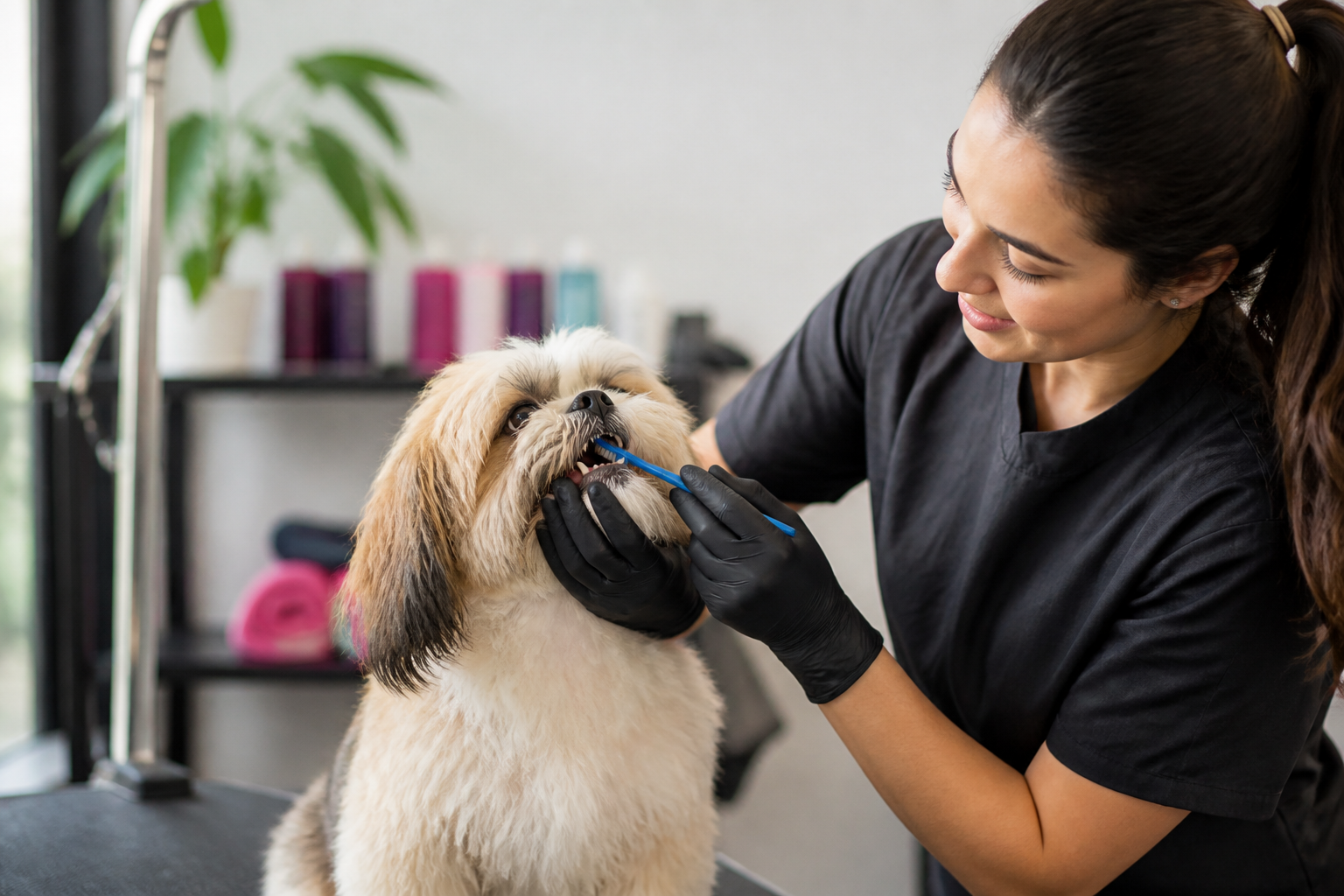
When you see "teeth cleaning" on a grooming menu, it almost always refers to teeth brushing. This involves a groomer using a pet-safe toothbrush and toothpaste to scrub the visible surfaces of your dog's teeth. It is a surface-level service meant to freshen breath and remove very recent plaque before it hardens into tartar.
A professional medical cleaning is a different procedure entirely. Veterinarians call this a dental prophylaxis. It involves specialized tools to scrape away hardened tartar, also known as calculus. Most importantly, a vet cleans the area beneath the gumline where bacteria hide. This is where the majority of dental disease starts.
Groomers are talented stylists, but they are not medical professionals. They do not have the licensing or the equipment to perform a deep medical cleaning. Brushing is a great maintenance step, but it is not a substitute for a vet visit if your dog already has significant buildup or red, inflamed gums.
The Reality of Anesthesia-Free Cleaning
You might see some facilities offering anesthesia-free dental cleanings. This can sound appealing because many owners worry about putting their dogs under for a procedure. However, most veterinary experts caution against this for several reasons.
First, a dog that is awake will not sit perfectly still while someone uses sharp metal tools inside their mouth. This makes it impossible to clean safely under the gumline. If that area is not cleaned, the source of the infection remains. It is like mopping a floor but leaving a pile of trash under the rug.
Second, the process can be very stressful or even painful for the dog. If a dog has sensitive gums or an undiagnosed cracked tooth, a layperson trying to scale that tooth can cause significant distress.
Key Takeaway: Cosmetic brushing at the groomer is excellent for maintenance, but it cannot treat existing dental disease or remove tartar from under the gums.
Why Groomers Cannot Perform Medical Scaling
There are legal and safety reasons why your groomer should not be scaling your dog's teeth with metal tools. In many states, any procedure that involves scaling or hand tools is considered a medical act that must be supervised by a veterinarian.
Risk of Enamel Damage
When a vet scales a dog's teeth, they follow it up with a high-speed polish. This is because scaling leaves microscopic scratches and grooves on the tooth enamel. If those grooves are not polished smooth, they actually provide more surface area for bacteria to latch onto. This means that if a groomer scales the teeth without polishing, your dog's teeth might actually get dirty much faster than they did before.
Bacteremia Concerns
Scaling teeth releases bacteria from the mouth into the bloodstream. In a veterinary setting, the doctor can assess if the dog needs antibiotics or a specialized rinse to manage this. For dogs with certain heart conditions or weakened immune systems, this sudden release of bacteria can be dangerous.
Hidden Problems
A veterinarian uses dental X-rays to see what is happening inside the jawbone and at the roots of the teeth. A groomer might see a white tooth and think it is healthy, while a vet sees an abscessed root on an X-ray. Relying only on a groomer for dental care might lead you to believe your dog is healthy when they are actually in pain.
Signs Your Dog Needs a Veterinarian
If you are unsure whether your dog needs a simple brush or a trip to the clinic, look for these common red flags. If you notice any of these, skip the grooming add-on and call your vet. You can also review warning signs of dental disease in dogs.
- Heavy brown or yellow buildup on the teeth
- Gums that bleed when touched or during play
- Persistent foul breath that does not go away after a meal
- Loose or missing teeth
- Pawing at the mouth or face
- Dropping food or refusing to eat hard kibble
- Swelling under the eye or along the jawline
Vet Tip: If your dog has red, puffy, or bleeding gums, do not ask a groomer to brush their teeth. Brushing inflamed gums can be very painful and may cause further irritation. Consult your vet first to address the underlying gingivitis.
How Your Groomer Can Help
Even though they should not do the deep cleaning, your groomer is still an essential part of your dog's health team. Because they see your dog regularly and get close to their face, they are often the first people to notice a new problem.
A good groomer will tell you if they see a broken tooth or a growth on the gums. If your dog's breath is exceptionally bad, they might suggest you schedule a vet checkup. Having your groomer brush your dog's teeth during their monthly visit is a fine way to keep the mouth feeling fresh, provided your dog's teeth are already in good condition.
Bottom line: Think of your groomer as the person who helps your dog "floss" and keep things tidy, while your vet is the "oral surgeon" who handles the heavy lifting.
At-Home Dental Care Strategies
The best way to avoid expensive vet bills and stressful procedures is to take care of your dog's teeth at home. Consistency is more important than anything else. Brushing once a year at the groomer will not do much, but brushing three times a week at home can change everything. For additional guidance, explore our dog dental care selection.
BaxterBoo carries a wide variety of tools to help you succeed. We offer specialized pet toothbrushes, finger brushes, and flavored toothpastes that taste like poultry or beef. Never use human toothpaste on a dog, as it contains ingredients like xylitol or fluoride that can be toxic to them.
Step-by-Step: Brushing Your Dog's Teeth
Step 1: Get them used to the taste. Let your dog lick a small amount of pet-safe toothpaste off your finger for a few days so they view it as a treat.
Step 2: Introduce the brush. Rub the brush or a finger mitt along their lips and front teeth gently without any pressure.
Step 3: Start the scrub. Gently lift the lip and brush in small circles along the gumline. Focus on the outside of the teeth, as this is where most buildup happens.
Step 4: Reward and praise. Always follow a brushing session with a high-value treat or a favorite game so they associate the routine with something positive.
The Role of Dental Treats and Toys
If your dog absolutely will not tolerate a toothbrush, you have other options to help manage plaque. Dental chews like Greenies are designed with a specific texture that helps scrub teeth as the dog bites down. Many of these products carry the Veterinary Oral Health Council (VOHC) seal of approval, which means they have been tested for effectiveness. You can compare options in our dog dental and breath care category.
Chewing is a natural way for dogs to clean their teeth. Durable rubber toys like those from Kong can be stuffed with healthy treats to encourage long chewing sessions. This mechanical action helps scrape away soft plaque before it hardens.
However, be careful with very hard items. Real bones, antlers, and heavy nylon bones can be harder than the tooth enamel itself. This often leads to fractured teeth, especially in powerful chewers. If you cannot indent the item with your thumbnail, it might be too hard for your dog's teeth.
Using the BaxterBoo Pharmacy for Dental Needs
Sometimes, dental health requires more than just a toothbrush. If your veterinarian diagnoses your dog with advanced dental disease or suggests a specific diet to manage plaque, our pet pharmacy is here to help. Through our partnership with Pet's Choice, we offer a wide range of FDA-approved medications and prescription pet foods.
We carry prescription dental diets from brands like Royal Canin and Farmina Vet Life. These foods are formulated with a specific kibble size and texture that works like a squeegee on the tooth surface. They also often contain minerals that bind to calcium in the saliva, preventing it from turning plaque into hard tartar.
If your dog needs a professional cleaning at the vet, they might be sent home with pain relief or antibiotics to manage infection. Our pharmacy can fulfill these prescriptions easily. You can manage your pet's medications through our online system, making it simple to keep up with their health needs without multiple trips to different stores.
Choosing the Right Food for Oral Health
Diet plays a massive role in how quickly tartar builds up. While some people believe that all dry kibble cleans teeth, most standard kibble actually shatters as soon as a dog bites it. This provides very little cleaning action.
If your dog is prone to dental issues, look for foods with larger, fibrous kibbles. Some brands we carry, like NutriSource or Stella and Chewy's, offer recipes that prioritize high-quality ingredients that support overall wellness, which in turn supports a healthy immune system and mouth.
For dogs that have already lost teeth or have very sensitive mouths, wet food or rehydrated options like those from The Honest Kitchen might be necessary. While these do not provide mechanical cleaning, they are much easier for a senior dog to manage.
Integrating Dental Care into Your Routine
The key to pet health is making it part of your daily life rather than a rare event. You can set a reminder on your phone to brush your dog's teeth every other day. If you use a recurring service like our Autoship programme, you can ensure that you never run out of dental treats or toothpaste.
Autoship is especially useful for items you use daily, such as Greenies or specialized dental diets. Not only does it save you time, but it also provides a discount on your orders. Plus, it qualifies you for a free MVP Gold membership, which earns you points on every purchase you make with us. Review the available benefits through the MVP Rewards programme.
Managing Dental Health in Senior Dogs
As dogs age, their dental needs become more complex. Senior dogs are more likely to have underlying issues like heart disease or kidney problems, which makes anesthesia a bigger concern for owners. This is where regular maintenance earlier in life pays off.
If you have a senior dog with existing dental issues, work closely with your vet. They may perform blood work to ensure the dog is a good candidate for a professional cleaning. Keeping a senior dog's mouth clean is vital because dental infections can strain their already aging organs.
If your senior dog has lost many teeth, they can still live a happy life. They just need softer food and perhaps some adjustments to their toy selection. Soft plush toys or lightweight rubber toys are often better for older mouths than hard nylon chews. For more feeding considerations, read Should Senior Dogs Eat Wet or Dry Food?.
Common Myths About Dog Teeth
There are many misconceptions that lead owners to make the wrong choices for their pets. Let's clear up a few of the most common ones.
- Myth: Bad breath is normal for dogs. While a dog's breath won't smell like mint, it shouldn't be offensive. Foul breath is almost always a sign of bacteria and decay.
- Myth: Hard food cleans teeth perfectly. Most kibble is swallowed whole or shatters instantly. Specific dental diets are needed for a real cleaning effect.
- Myth: If they are eating, they aren't in pain. Dogs are incredibly stoic. Many will continue to eat even with a broken tooth or a massive abscess because their survival instinct is so strong.
- Myth: Groomers can replace the vet for dental care. As we have covered, a groomer provides a beauty service, while a vet provides a health service.
Supporting the Whole Pet
Dental health does not exist in a vacuum. A dog with a healthy gut and a strong immune system will often have a healthier mouth. Feeding high-quality brands like Acana, Orijen, or Open Farm ensures your dog gets the nutrients they need to keep their tissues healthy.
We have been in business since 2006, and our warehouse in Vernon Hills is filled with over 500 brands that we have carefully selected. We only carry products that we would feel comfortable giving to our own pets. Whether you are looking for a new toothbrush, a bag of premium food, or a prescription medication from our pharmacy, we are here to support your journey as a pet owner.
Key Takeaway: A holistic approach to dental care includes regular at-home brushing, high-quality nutrition, dental chews, and annual veterinary checkups.
Conclusion
While it is tempting to let your groomer handle everything during a spa day, a medical dental cleaning is not a DIY or grooming task. Use your groomer's teeth brushing service as a helpful supplement to your home care routine, but do not rely on it to fix serious dental issues. If your dog has stinky breath, yellow buildup, or red gums, the best next step is a professional evaluation from your veterinarian.
- Groomers provide cosmetic brushing, not medical scaling.
- Deep cleaning requires anesthesia to reach beneath the gumline safely.
- At-home brushing is the most effective way to prevent future dental disease.
- BaxterBoo offers the brushes, treats, and pharmacy services you need to succeed.
For all your dental care supplies and prescription needs, visit our dog dental care category or check out our pet pharmacy to keep your dog's smile healthy for years to come.
FAQ
Is it worth paying a groomer to brush my dog's teeth?
If your dog is already at the groomer and they have healthy teeth, a professional brush can help freshen their breath and remove surface plaque. It is a great maintenance service if you struggle to brush their teeth at home. However, it will not remove hard tartar or treat gum disease, so you should still maintain a regular home routine and see a vet.
Can a groomer remove tartar from my dog's teeth?
No, groomers should not attempt to remove hardened tartar with scaling tools. Removing tartar requires scraping near and under the sensitive gumline, which can be painful and dangerous for an awake dog. This procedure is a medical task that should only be performed by a veterinarian, usually under anesthesia to ensure it is thorough and pain-free.
Why does my vet use anesthesia for dental cleanings?
Anesthesia allows the vet to perform a complete exam, including X-rays and cleaning deep under the gumline, without causing the dog pain or stress. It also prevents the dog from accidentally inhaling bacteria or water during the cleaning process. Anesthesia-free cleanings are usually only cosmetic and leave the most dangerous bacteria behind.
How often should my dog's teeth be professionally cleaned?
Most dogs benefit from a professional veterinary cleaning once a year, though some smaller breeds may need it every six months due to crowded teeth. Between these visits, you should aim to brush your dog's teeth at home daily or at least several times a week. Regular checkups will help your vet determine the best schedule for your specific pet.






