
 Save 15% on your 1st Autoship learn more

 Email us
 Live Chat
 FAQs
FAQs





Introduction
The daily struggle of wrestling a toothbrush into a reluctant dog's mouth is a scene many pet owners know too well. You start with good intentions, but after three minutes of chasing your pup around the kitchen and getting more toothpaste on the floor than on their teeth, it is easy to give up. At BaxterBoo, we understand that while brushing is the gold standard for oral hygiene, it is not a realistic daily habit for every household. Fortunately, you can still protect your dog's oral health using tools that work with their natural behaviors rather than against them. This guide covers the most effective powders, treats, toys, and specialized diets that fight plaque and tartar without the need for a toothbrush. Our goal is to help you build a routine that is sustainable for you and comfortable for your dog.
The Reality of Canine Dental Disease
Dental health is one of the most overlooked aspects of pet care, yet it has a massive impact on your dog's overall longevity. By the age of three, most dogs already show some signs of periodontal disease. This starts when bacteria and food particles form a sticky film called plaque. If that plaque is not disrupted within 48 hours, it minerals into a hard substance known as tartar or calculus. You can usually see this as yellow or brown buildup along the gumline.
Tartar cannot be removed by simple chewing or light brushing. Once it forms, it acts as a fortress for bacteria. These bacteria cause inflammation of the gums, known as gingivitis, and can eventually enter the bloodstream. From there, the bacteria can travel to major organs, including the heart, liver, and kidneys. Maintaining a clean mouth is not just about avoiding bad breath. It is about protecting your dog from chronic organ damage and painful tooth loss. For more warning signs, read our guide to recognizing bad teeth in dogs.
Vet Tip: If your dog has red, bleeding gums or loose teeth, a no-brush routine will not be enough to fix the problem. Please consult your veterinarian for a professional oral exam to determine if an anesthetized cleaning or extractions are necessary before starting a new home care plan.
Dental Powders: The Invisible Cleaner
One of the easiest ways to clean your dog's teeth involves almost no effort from you or your pet. Dental powders are designed to be sprinkled directly onto your dog's meals. These powders often use systemic ingredients that work from the inside out to change the chemistry of your dog's saliva. One convenient option is ProDen PlaqueOff Powder Dog and Cat Teeth Care.
The most well-known ingredient in this category is a specific type of seaweed called Ascophyllum nodosum. When your dog ingests this seaweed, its compounds are absorbed into the blood and eventually secreted back into the mouth through the saliva. This process helps to soften existing tartar and prevents new plaque from sticking to the teeth.
Another option involves probiotic powders. These products introduce beneficial bacteria into the mouth to crowd out the harmful, odor-causing bacteria. By balancing the oral microbiome, these powders can significantly reduce bad breath and slow down the formation of bio-films on the tooth surface.
How to use dental powders effectively:
- Follow the scoop instructions based on your dog's weight.
- Apply the powder to every meal to maintain consistent levels in the saliva.
- For picky eaters, mix the powder with a small amount of wet food or a splash of water.
- Allow at least four to eight weeks of consistent use to see visible results in tartar reduction.
Key Takeaway: Dental powders are the best choice for dogs that refuse to have their mouths touched. They provide a passive way to fight plaque 24/7 without any physical handling.
The Power of Mechanical Abrasion
If your dog is an active chewer, you have a built-in advantage in the fight against dental disease. Mechanical abrasion is the physical process of rubbing plaque off the teeth. When a dog chews on a firm object, the surface of that object scrapes against the tooth, acting much like a squeegee.
However, not all chew toys are created equal. Some are too soft to provide any cleaning benefit, while others are so hard that they can actually fracture a dog's teeth. The "knee test" is a good rule of thumb for safety. If it would hurt to hit your own knee with the object, it is likely too hard for your dog's teeth. Avoid antlers, dried hooves, and nylon bones, as these are common culprits for broken carnassial teeth. For more ideas, explore our dental dog toys.
Instead, look for rubber toys with nubs, ridges, or deep grooves. As your dog's teeth sink into the rubber, the nubs rub against the enamel and the gumline. You can increase the effectiveness of these toys by smearing a small amount of dog-safe enzymatic toothpaste into the grooves. Your dog will do the work of "brushing" while they try to lick the paste out of the toy.
Dental Chews and Functional Treats
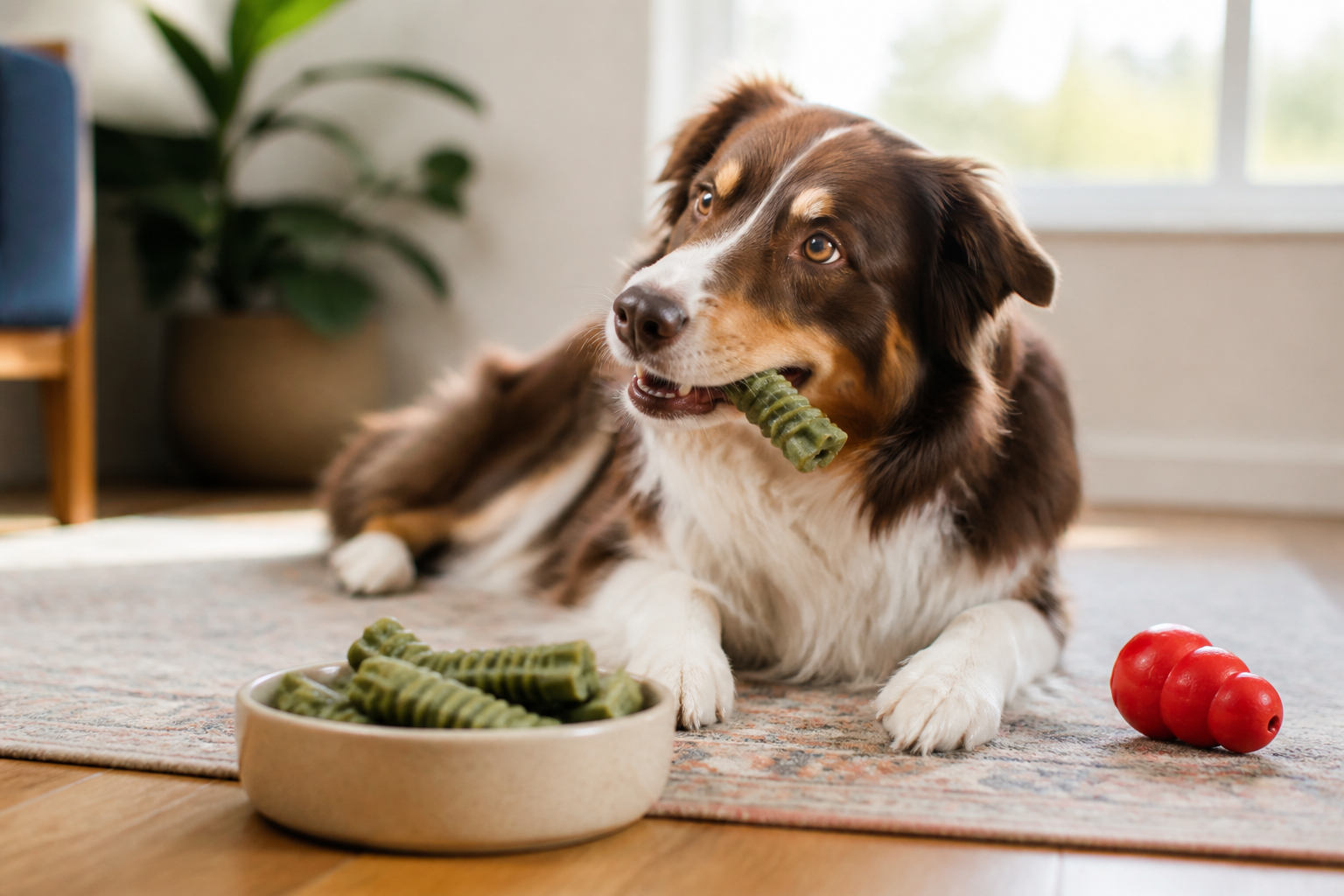
Dental chews are perhaps the most popular alternative to brushing. These treats are engineered with specific textures that encourage prolonged chewing. Many also include ingredients like sodium hexametaphosphate, which binds to calcium in the mouth to prevent it from turning plaque into hard tartar. Browse our dog dental treats for options suited to different sizes and chewing styles.
The effectiveness of a dental chew depends entirely on how long the dog actually chews it. If your dog gulps the treat in two seconds, the mechanical cleaning benefit is lost. This is why choosing the correct size is vital. A treat that is too small for a large dog is a choking hazard and a dental failure. A treat that is too large for a small dog can add too many calories to their daily diet.
Quick Answer: Yes, you can maintain your dog's oral health without a toothbrush by using a combination of VOHC-approved dental chews, water additives, and specialized powders. These methods work through mechanical scraping and chemical plaque disruption to keep the mouth healthy.
Water Additives: Mouthwash for Dogs
Water additives are the ultimate "set it and forget it" solution for busy pet owners. These are liquid concentrates that you add to your dog's water bowl every time you refill it. They function similarly to a human mouthwash, using enzymes or mild antiseptic agents to kill bacteria on contact. You can compare water additives with other options in our dental and breath care collection.
While water additives are not usually strong enough to remove thick tartar on their own, they are excellent at controlling breath odor and keeping the bacterial load in the mouth low. They are especially useful in multi-dog households where brushing every pet every day is a logistical challenge. Most additives are odorless and tasteless, so even the most skeptical dogs will usually drink them without hesitation.
Specialized Dental Diets
For dogs that are highly prone to dental issues, such as toy breeds or seniors, a standard kibble might not be doing enough. Most generic dry dog foods crumble easily when the tooth hits them. This provides almost no cleaning benefit.
Specialized dental diets, however, are formulated with a larger kibble size and a fiber matrix that does not shatter. When your dog bites down, the tooth sinks into the kibble, and the fibers scrub the surface of the tooth all the way to the gumline. Many of these diets also contain plaque-reducing minerals.
At BaxterBoo, we see many owners find success with these diets for dogs that have persistent tartar issues. Some of these formulations are available over the counter, while others require a veterinary prescription. Our pet pharmacy offers FDA-approved prescription pet foods through our partnership with Pet's Choice. If your vet recommends a specific dental diet like Royal Canin Dental or Hill's t/d, we can help you fulfill that prescription for home delivery.
Bottom line: Prescription dental diets turn every meal into a cleaning session by using a specialized kibble structure that does not crumble.
Dental Wipes and Finger Brushes
While this guide focuses on "no-brush" methods, some dogs are okay with light mouth handling but hate the bulky feeling of a traditional toothbrush. Dental wipes are a great middle ground. These are pre-moistened pads that you wrap around your index finger. You can find additional guidance in our pet dental care tips.
Wipes allow you to feel exactly where you are cleaning. You can gently rub the outer surfaces of the teeth and along the gumline to physically remove the daily film of plaque. Because there are no long handles or vibrating bristles, most dogs find this much less threatening. It is a quick process that can be done while you are sitting on the couch together.
Transitioning to wipes:
- Let your dog lick the wipe first to get used to the flavor.
- Start by only wiping the front "canine" teeth.
- Reward them with a high-value treat immediately.
- Gradually move toward the back molars over several days.
Understanding the VOHC Seal
When shopping for dental products, you will see many claims about "veterinarian recommended" or "clinically proven." To cut through the marketing fluff, look for the Veterinary Oral Health Council (VOHC) Seal of Acceptance.
The VOHC is an independent organization of veterinary dental specialists. They only award their seal to products that provide data from controlled clinical trials. These trials must prove that the product reduces plaque or tartar by at least 20 percent. If a product does not carry the seal, it does not necessarily mean it is bad, but it does mean it has not met the rigorous independent testing standards of the council. Many brands we carry, such as Greenies and certain PlaqueOff products, hold this seal.
The Role of Professional Veterinary Care
No matter how diligent you are with at-home care, most dogs will eventually need a professional cleaning. Just as humans go to the dentist despite brushing and flossing, dogs need a deep clean to reach the areas under the gumline where a chew or a wipe cannot reach.
During a professional cleaning, your veterinarian will use an ultrasonic scaler to remove tartar and then polish the teeth to smooth out any microscopic scratches. They will also take X-rays to look for abscesses or bone loss hidden beneath the gums. This is the only way to truly "reset" a dog's oral health. Your at-home routine is what maintains that clean slate and extends the time between these professional visits.
Vet Tip: Small breeds like Chihuahuas and Yorkies have crowded teeth, which traps bacteria more easily. These breeds often require more frequent professional cleanings, sometimes as often as once a year, regardless of home care.
Building a Consistent Routine
The secret to success is not finding one perfect product, but rather layering different methods. A single dental chew once a week will not make a difference. However, a daily dental powder combined with a high-quality chew toy and a water additive creates a multi-front attack on bacteria.
A simple, effective routine might look like this:
- Morning: Add a scoop of dental powder to breakfast.
- Daytime: Leave out a nubby rubber toy for solo play.
- Evening: Give one VOHC-approved dental chew after dinner.
- Constant: Use a water additive in their main drinking bowl.
This routine takes less than two minutes of your active time but provides four different ways to protect your dog's teeth. Consistency is far more important than perfection. If you skip a day, just start again the next morning. For repeat purchases, our Autoship programme can help keep routine supplies on schedule.
Why Quality Matters
It can be tempting to grab the cheapest dental treats from a big-box store, but ingredients matter. Some lower-quality treats are high in calories and sugar, which can actually contribute to bacterial growth in the mouth. Always check the ingredient list for unnecessary fillers.
At BaxterBoo, we pride ourselves on being an expertly curated warehouse. We handpick the brands we stock because we care about what goes into your pet's body. Whether you are looking for premium supplements from Zesty Paws or specialized dental treats from Greenies, we focus on products that offer real value without compromising on quality. Since 2006, we have helped millions of pet owners find the right gear and wellness products to keep their companions healthy.
Signs Your Current Routine Needs Adjusting
Even with a great no-brush routine, you should check your dog's mouth once a week. Lift the lip and look at the back molars. If you see thick, tan buildup or a dark red line where the tooth meets the gum, your current strategy might need more "muscle."
Bad breath is usually the most reliable indicator of oral health. While "dog breath" is normal, it should not be offensive. If your dog's breath smells rotten, metallic, or like garbage, there is likely an infection or significant tartar buildup that requires a vet's attention. Do not try to mask the smell with more treats. Address the underlying cause with your veterinarian to prevent the problem from worsening.
Key Takeaway: A successful no-brush routine uses a "multi-modal" approach. By combining chemical, systemic, and mechanical tools, you can significantly reduce the risk of periodontal disease.
The BaxterBoo Difference
We know that managing a dog's health can feel overwhelming, especially when they are resistant to basic care like brushing. That is why we offer a wide variety of solutions to fit different lifestyles and budgets. From our MVP Rewards programme that helps you save on every purchase to our Autoship service that ensures you never run out of dental chews, we are here to make pet care easier.
Our team in Vernon Hills, Illinois, works every day to ensure you have access to the best products on the market. We are more than just an online store. We are a resource for pet parents who want the best for their dogs. If your dog needs more than just a dental chew, remember that our pharmacy is available for prescription medications and diets. We are committed to supporting your pet's health through every stage of their life.
Conclusion
Keeping your dog's teeth clean does not have to be a daily battle. By choosing the right dental powders, water additives, and mechanical chews, you can maintain a healthy mouth without ever picking up a toothbrush. These tools work by disrupting plaque before it hardens into tartar and by using your dog's natural urge to chew to your advantage. Remember to look for the VOHC seal for peace of mind and stay consistent with your chosen routine. If you notice persistent bad breath or inflamed gums, reach out to your veterinarian for a professional assessment. Your dog's smile is a window into their overall health, and with these simple steps, you can keep that window clear for years to come.
Bottom line: A consistent no-brush routine using high-quality products is far more effective than an occasional, stressful attempt at brushing.
FAQ
Is it really possible to never brush my dog's teeth?
While brushing is the most thorough way to remove plaque, many dogs live long, healthy lives without it if their owners use a combination of other effective tools. Using VOHC-approved dental chews, powders, and water additives together can provide enough protection to significantly slow down tartar buildup. However, you should still expect to need professional veterinary cleanings periodically to reach the areas these home methods cannot touch.
Can I give my dog human mouthwash instead of a water additive?
No, you should never give a dog human mouthwash or toothpaste. Many human oral care products contain xylitol, which is an artificial sweetener that is highly toxic to dogs and can cause life-threatening liver failure or low blood sugar. Human products also often contain fluoride or foaming agents like sodium lauryl sulfate that are not meant to be swallowed and can cause severe stomach upset.
How do I know if a dental chew is safe for my dog's teeth?
A safe chew should have some "give" or flexibility when you press into it. If a chew is as hard as a rock and does not indent when you press your thumbnail into it, it carries a higher risk of breaking a tooth. Always supervise your dog with a new chew to ensure they are actually chewing it rather than trying to swallow large pieces, which can cause choking or intestinal blockages.
Why does my dog's breath still smell even after using dental treats?
Persistent bad breath is often a sign that tartar has already hardened or that there is an underlying infection beneath the gumline. At-home dental products are designed to prevent new plaque from forming, but they generally cannot remove thick, existing tartar. If the smell persists, your dog likely needs a professional cleaning by a veterinarian to remove the source of the bacteria and check for any hidden dental issues.






