Save 15% on your 1st Autoship learn more

 Email us
 Live Chat
 FAQs
FAQs





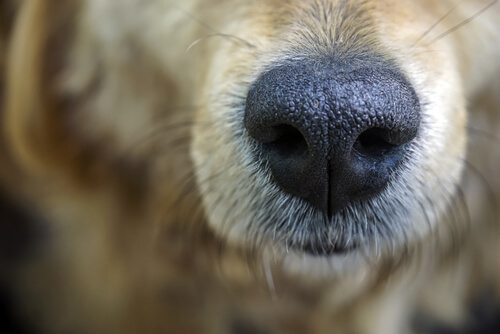
Your dog’s nose is a truly remarkable thing. He has over 300 million scent receptors in his nose whereas you have only about 5 million. Not only that, he smells “in stereo.” Each of his nostrils has two parts, one for breathing and the other for smelling. When you inhale, you detect odors in only a small region of your nasal cavity roof as the air comes in. Nearly all of the odors you smell while breathing just go in and out of your nose along with the air itself.
Your dog’s nose has an entirely different breathing mechanism. When he inhales, a good 12 percent of the air goes into a special “odor pocket” at the back of his nose that’s dedicated to smelling; the other 88 percent goes into his pharynx and on into his lungs. The air in the pocket goes through turbinates, a labyrinth of bony structures that separate the odors into their component molecules based on their chemical properties. The turbinates are lined with tissue containing olfactory receptors. When the odor molecules reach these receptors, they recognize the individual molecules by shape and send electrical signals to your dog’s brain for analysis. To top it all off, the part of your dog’s brain dedicated to analyzing odors is 40 times larger than the corresponding part of a human brain, relatively speaking.
To put these statistics into more understandable form, consider that you can smell it when you put a teaspoon of sugar in your coffee. Your dog can smell a teaspoon of sugar in a million gallons of water, enough to fill two Olympic-sized swimming pools! Or consider that you can smell a cake. He can smell every single ingredient that’s in it!
Tracking and Other Abilities
Scent, not vision, is your dog’s primary way of “seeing” the world. His world is filled with scents that humans simply never know. That’s why dogs are so good at sniffing out bombs and explosive devices; hidden drugs and other banned substances; and bodies buried under snow, water, or debris. That’s also why they’re masters at search and rescue and at tracking the trails of lost toddlers, hikers, or fleeing criminals.
Dogs have a second olfactory capability that humans lack. Dogs have a special organ at the bottom of their nasal passage that humans don’t have. It’s called the vomeronasal organ, also known as Jacobson’s organ. What this organ does is detect pheromone molecules. Pheromones are the chemicals unique to each animal species, including humans, related to sex and/or fear. Your dog’s Jacobson’s organ acts like a dedicated computer server. It’s dedicated to pheromone molecules, nothing else, and doesn’t allow other odor molecules to mix with them. The Jacobson’s organ transmits the pheromone molecules to his brain through its own set of nerves. When they arrive in his brain for analysis, the brain has its own section dedicated specifically to them. It’s a highly sophisticated system.
Scent hounds such as Beagles, Bloodhounds, Coonhounds, and Dachshunds, are the champions of scent ability. They can differentiate one person’s footprints from those of the dozens or hundreds of other people who have walked in the same place. They can smell a person’s fingerprints left weeks ago on a wall or other object.
Can Dogs Smell Fear?
The myth that dogs can smell it when a human is afraid of them has been around for decades if not centuries. Is that really true? Yes, it is – if you don’t define “fear” too literally. Fear is an emotion and dogs can’t smell emotions per se. What they can and do smell, however, are the chemicals humans emit when they’re afraid. Have you ever noticed that the sweat you produce when you vigorously exercise smells different than the sweat you produce when you’re nervous, anxious, or afraid? Dogs smell that difference immediately and recognizes which physical or psychological activity caused which odor(s).
In addition, even though dogs rely on sight much less than on their sense of smell to perceive the “big-picture” world, they nevertheless key in on visual details much better than humans do. They’re very attuned to the nuances of human facial expressions and body language, including slight, almost imperceptible, physical movements.
By smelling a human’s fear-produced pheromones and stress-related hormones like adrenaline and seeing a human’s almost reflexive and unconscious stiffening-up and clenched-teeth physical movements, dogs definitely can and do sense fear. So while technically they can’t smell fear, they certainly know when someone is afraid of them.
Then the question becomes, if a dog senses your fear, does that make him more likely to bite you? Research indicates that the answer is no. What really matters is whether the dog is afraid of you or thinks you’re encroaching on his territory. Most people who are terrified of dogs in general stare directly at any dog they see, wanting to watch its every movement and fearing the worst. That’s the worst possible thing to do. Direct eye contact is the way dogs and all other pack animals challenge each other.
Experts say that if you see an unfamiliar dog and are concerned about being bitten, the first thing you should do is quit moving forward, calmly pivot your body slightly to your left or right, and stand still, watching him out of the corner of your eye without turning your head toward him. Try to stay as calm and relaxed as possible so you won’t give off any hormones or pheromones that tell him you’re afraid. Don’t stiffen up or clench your teeth or fists. Never run away; that makes you look like prey and gives him an excuse to chase you. Never yell at him, hoping to bully him into backing down; it will only antagonize him.
If you have the presence of mind to do so, notice how he’s holding his tail. If it’s between his legs, that means he’s afraid. If it’s straight out, that means everything is okay. If it’s up, that means he’s warning you not to come any closer. When you don’t, you’re telling him you have no intention of invading his territory and don’t expect him to invade yours either.