Save 15% on your 1st Autoship learn more

 Email us
 Live Chat
 FAQs
FAQs





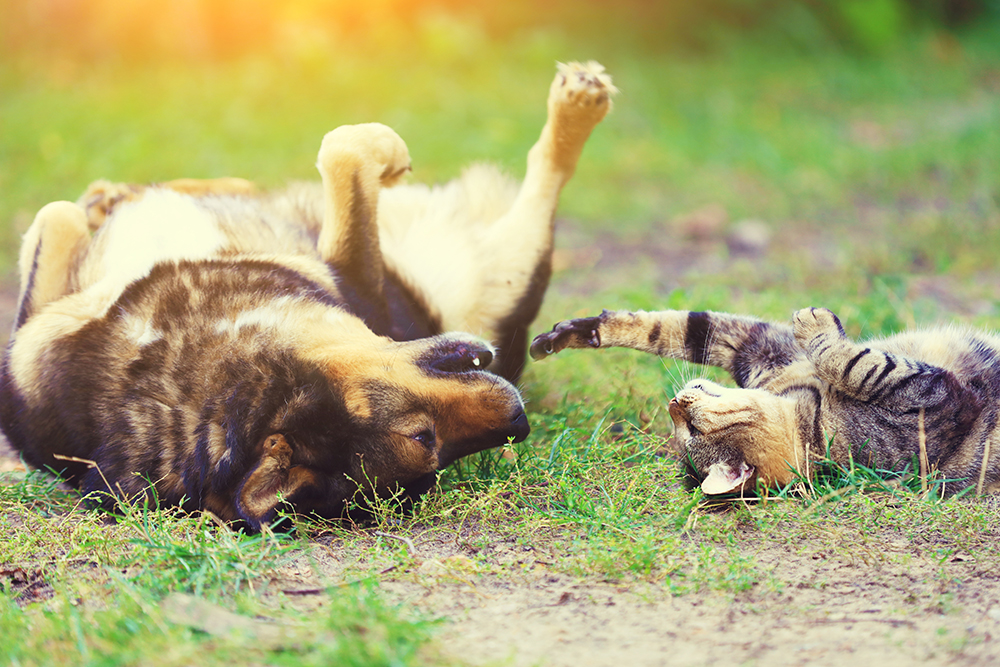
Cats and dogs are different in many ways, which may account for why some people have an affinity for one over the other and even get into lighthearted arguments about which makes the better pet. However, for all the differences in the ways that cats and dogs relate to humans, they are actually very similar in some respects.
For example, both cats and dogs react to a plant called Nepeta cataria, more commonly known as catnip. They don't always react the same way to catnip, and a dog's reaction may be more subtle than a cat's. This may be the reason why the plant is more associated with cats, but it has benefits for dogs as well.
Why Do Dogs and Cats React To Catnip?
Catnip contains a chemical called nepetalactone in its stems but more so in its flowers and leaves. When the essential oil is extracted from catnip leaves, it is rich in nepetalactone, or you can release the chemical by crushing the leaves and flowers. Dogs and cats both have nerve receptors in their noses and stomachs that are sensitive to nepetalactone. This means that ingesting the catnip or even just smelling it may produce a reaction from them.
That doesn't mean that catnip affects all cats and all dogs. Some do not show any reaction or change of behavior in response to nepetalactone. This is a normal variation and not a sign that there is anything wrong with your pet. It may happen because your dog or cat doesn't have as many nepetalactone receptors, or sometimes overexposure to catnip can cause pets to develop a tolerance for it.
How Does Catnip Affect Dogs?
When a cat inhales or ingests nepetalactone, it typically causes a rush of euphoria during which the cat becomes energetic and hyper, sometimes displaying aggressive behavior. After the initial rush of euphoria, the cat becomes calm and relaxed. However, not all cats exhibit the exact same reaction to catnip. Some skip the burst of energy and hyperactivity and go straight to calm and relaxation. This is similar to the reaction that dogs typically have to catnip. It seems to act as a mild sedative for them, causing them to become calm and placid.
How Can Catnip Help Anxious Dogs?
Like human beings, dogs can suffer from psychological conditions such as anxiety. Anxiety in dogs can take many different forms. It is normal for your dog to experience anxiety during certain stressful situations, such as thunderstorms or vet visits. However, it is unhealthy for him to be anxious all the time.
If your dog experiences chronic anxiety, your vet can prescribe medications to relieve his symptoms. However, these drugs may have harmful side effects and can be expensive. Giving your dog catnip every day may help to relieve her symptoms. She can't overdose on it, and the only side effect is that she may stop reacting to it after a while if she builds up a tolerance for it. It won't hurt your dog to try catnip for her anxiety, and if it doesn't do her any good, you can always go back to your vet for a prescription.
You can also give your dog catnip prior to situations that you know are stressful for him, such as a ride in the car. The nepetalactone may help to calm him down so that he stays more relaxed even when in a situation that is usually stressful.
What Other Benefits Can Catnip Offer Dogs?
If your dog has trouble going to sleep or staying asleep at night, you can give her some catnip before bed. The sedative effect may cause her to relax and help her settle down. Even if she doesn't sleep, at least she shouldn't bother you while you are trying to rest.
Catnip has antiseptic qualities that help prevent infection. If your dog ever has a minor scrape or cut, you can rub some catnip on it. Not only may it help the wound heal cleanly, but its sedative effect may prevent him from feeling the pain as badly. Catnip can also help resolve mild gastrointestinal complaints, such as motion sickness or indigestion. Even if your dog doesn't respond to it, catnip has mosquito-repellent qualities.
How Can You Administer Catnip to a Dog?
One of the most fun ways to give your dog catnip is to give him a toy with a special compartment that you can fill periodically with fresh or dried Nepeta cataria. You could use cat toys for this purpose but because cats and dogs play with toys differently, your dog may not be interested. Refillable catnip toys for dogs are larger, which makes them easier for big dogs to handle. They come in designs intended to appeal to dogs and have features such as squeakers. They often come with a little vial of catnip so that you do not have to buy it separately.
There are many other ways you can give your dog catnip. You can feed it to her from your hand, sprinkle it over her food, or rub it on her body for her to lick off.
Are There Any Other Plants That Work Like Catnip on Dogs?
Anise is a plant that has a licorice-like flavor. The seeds are sometimes used as a seasoning. Anise seems to stimulate dogs the way catnip works on cats. Therefore, it might be a good thing to give your dog before playtime to get him excited about it. Anise seed is safe for dogs and can be added to their usual food or homemade treats. However, you have to make sure that it is anise and not star anise, which looks and smells similar but is a different plant.