
 Save 15% on your 1st Autoship learn more

 Email us
 Live Chat
 FAQs
FAQs





Introduction
You reach for your morning coffee and notice a layer of "fur glitter" already coating the bottom of your mug. You vacuumed yesterday, but the tumbleweeds of hair are already rolling across the hardwood floors again. Dealing with a heavy shedder can feel like a full-time job. We know the struggle well because we see it every day at BaxterBoo. Our customers in Vernon Hills and online often ask which tool will actually stop the shedding at the source. The truth is that the "best" brush depends entirely on your dog’s specific coat type and skin sensitivity. This guide will help you identify your dog’s coat and match it with the right tool to keep your home cleaner and your pet more comfortable.
Quick Answer: The best brush for shedding depends on the coat. Use an undercoat rake for double-coated breeds like Huskies, a slicker brush for curly or long hair, and a rubber curry comb for short-haired dogs like Labradors.
Identifying Your Dog’s Coat Type
Before you grab a tool, you need to know what you are working with. Not all fur is created equal. Some dogs have a single layer of hair that grows and sheds slowly. Others have a dense, soft undercoat that "blows" twice a year. Using the wrong brush can be ineffective or even painful for your pet.
Smooth and Short Coats
Breeds like Boxers, Beagles, and Great Danes have short, smooth hair that lies close to the skin. They do not get mats or tangles. However, they still shed tiny, needle-like hairs that stick to everything. These dogs need tools that massage the skin and pull away loose surface hair.
Double Coats
This is the most common coat for heavy shedders. Labradors, German Shepherds, Huskies, and Golden Retrievers all have two layers. The topcoat is tough and water-resistant. The undercoat is soft, thick, and designed for insulation. When you see big clumps of fur on your carpet, that is usually the undercoat.
Curly and Wooly Coats
Poodles and Doodles fall into this category. While they are often called "non-shedding," they actually just trap their shed hair within their curls. If you do not brush them regularly, that trapped hair turns into tight mats. These coats require tools that can penetrate deep into the curls to pull out loose strands.
Wire and Silky Coats
Wire-haired breeds like Terriers have a rough outer layer. Silky coats like those on Yorkies or Setters are fine and prone to tangles. Both need gentle tools that remove loose hair without breaking the delicate strands or irritating the skin.
The Power of the Slicker Brush
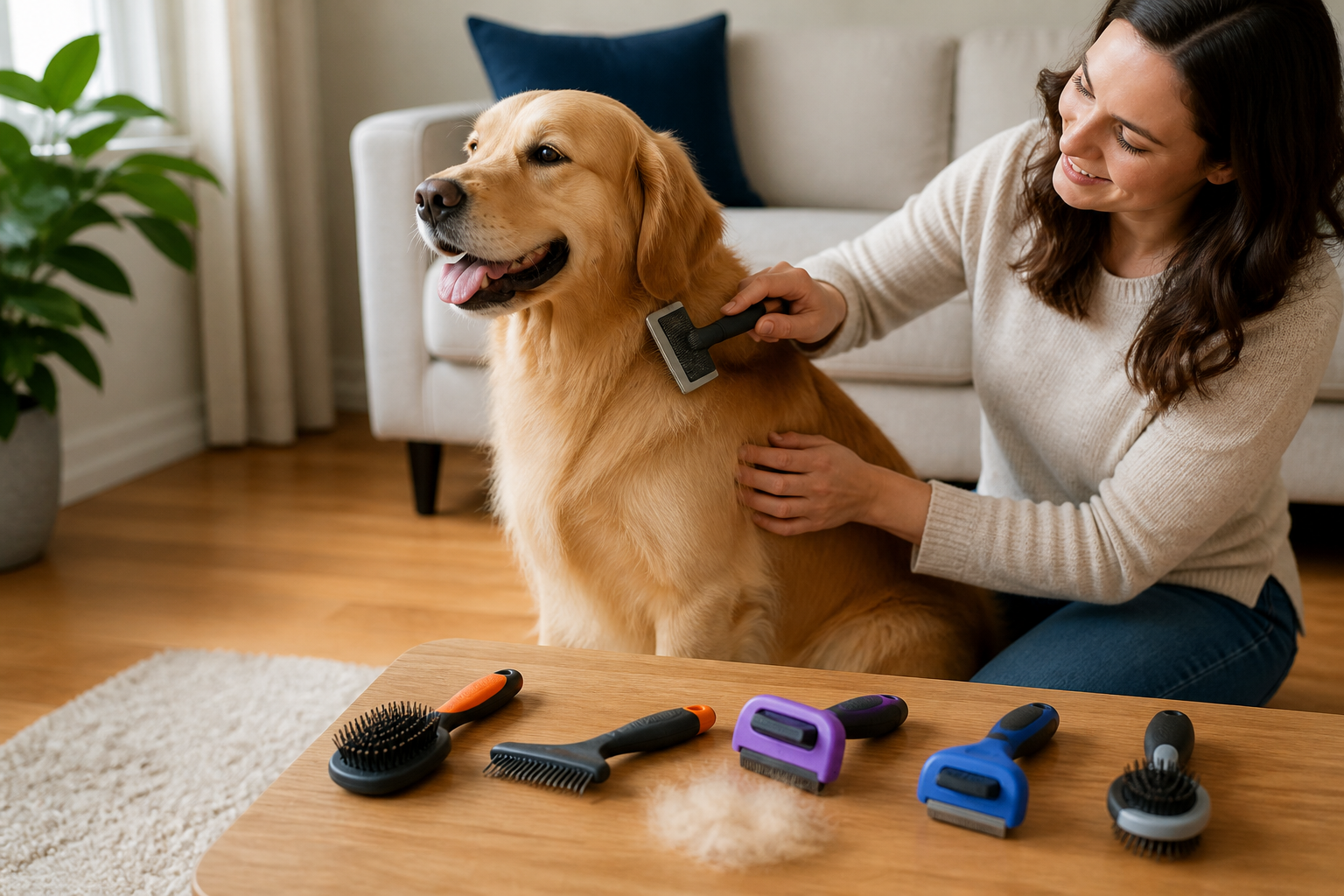
The slicker brush is perhaps the most versatile tool in any grooming kit. It features a flat or slightly curved head with rows of thin, flexible wire pins. These pins are slightly hooked to grab onto loose hair and debris.
If you have a dog with medium to long hair, a slicker brush is your best friend. It is excellent for removing loose fur before it falls off. It also helps break up small tangles. We carry several varieties of slicker brushes in our dog brushes and combs collection that work for different coat densities.
When using a slicker brush, use a light hand. The wire pins can be sharp if you press too hard. Always pull the brush in the direction of hair growth. If you encounter a mat, do not yank. Instead, use short, gentle strokes to tease the hair apart.
Key Takeaway: Slicker brushes are the "all-purpose" tool for medium, long, and curly coats. They remove loose hair and help prevent painful mats from forming.
Undercoat Rakes for Heavy Shedders
If you own a "floofy" dog like a Samoyed or an Australian Shepherd, a standard brush will not cut it. You need an undercoat rake. These tools look like a small garden rake with one or two rows of long, blunt metal tines.
The tines are designed to pass through the topcoat without damaging it. They reach deep into the thick undercoat to pull out dead hair. This is the most effective way to manage "coat blowing" season. It targets the fur that actually causes the mess in your house.
Undercoat rakes are also useful for removing "impacted" fur. This happens when the undercoat gets trapped and starts to feel like a hard carpet against the dog’s skin. Regular use of a rake keeps the skin ventilated and healthy.
Vet Tip: If your dog has a very thick undercoat, check the skin regularly for redness or hot spots. Impacted fur can trap moisture and bacteria against the skin. If you notice sores or a foul odor, consult your veterinarian for a skin assessment.
Managing Short Hair with Curry Combs
Many owners of short-haired dogs think they do not need a brush. Then they wonder why their black trousers are covered in white Beagle hair. For these dogs, a rubber curry comb is the perfect solution.
These brushes are usually oval-shaped and made of soft, flexible rubber. They have rubber "nubs" instead of bristles or pins. When you rub the comb in a circular motion, it creates friction that pulls out loose hair. It also stimulates the skin’s natural oils, giving the coat a healthy shine.
Most dogs love the feeling of a curry comb. It feels like a firm massage. It is also a great tool for bath time. You can use it to scrub shampoo deep into the coat to get a better clean. The KONG Zoom Groom Natural Rubber Dog Grooming Brush is one example of this type of tool.
The Role of De-Shedding Tools
Tools like the FURminator are very popular for a reason. They use a fine, stainless-steel edge that looks almost like a clipper blade. This edge reaches through the topcoat to grab the undercoat. These tools can remove a staggering amount of hair in a single session.
However, these tools must be used with caution. Because the edge is sharp, you can "brush burn" your dog if you go over the same spot too many times. We recommend using these once or twice a week at most.
Step 1: Ensure the coat is completely dry. / Never use a de-shedding tool on wet hair as it can cause breakage.
Step 2: Check for large mats or sores. / Work around any skin irritations or tangles first with a different tool.
Step 3: Use long, gentle strokes. / Avoid short, scrubbing motions. Move in the direction of the hair.
Step 4: Stop when the hair stops coming out in large clumps. / Over-brushing can damage the healthy topcoat.
For longer coats, a product such as the Warren London Long Hair De-Shedding Pet Brush is designed to reach through the coat and remove loose undercoat hair.
Bottom line: De-shedding tools are highly effective for double coats but require a gentle touch to avoid skin irritation.
Nutrition and Skin Health
Brushing is only half the battle. If your dog is shedding excessively year-round, it might be a sign of a nutritional deficiency or an underlying health issue. High-quality food rich in Omega-3 and Omega-6 fatty acids supports a strong hair follicle.
When the skin is dry or itchy, the hair becomes brittle and falls out more easily. This is common in dogs with environmental or food allergies. We often see pet owners try every brush on the shelf without realizing the problem is internal.
Our pharmacy at BaxterBoo offers a variety of solutions for skin health. Through our partnership with Pet's Choice, we provide FDA-approved medications for allergies and skin infections. We also carry prescription diets specifically formulated for skin and coat support. If your dog is losing hair in patches or has very red skin, a trip to the vet is necessary. They can provide a prescription that we can fill for you, often at a better value than the clinic.
For non-prescription grooming and nutritional options, browse our dog skin and coat care category. You can also read about supporting your dog’s skin and coat during dry air.
Creating a Positive Grooming Routine
Grooming should be a bonding experience, not a chore. If your dog hides when they see the brush, you might need to change your approach. Start with very short sessions.
Begin by letting your dog sniff the brush. Give them a high-value treat. Brush one small area for thirty seconds and then stop. Gradually increase the time as they become more comfortable.
Always brush in a quiet area without distractions. If your dog has a lot of shedding, it is often best to do this outside or on a floor that is easy to sweep. Some dogs are more relaxed after a long walk when they have less energy to wiggle.
Professional Grooming vs. At-Home Care
While we provide the tools for excellent at-home care, some situations require a professional. If your dog is severely matted, do not try to cut the mats out with scissors. A dog's skin is very thin and easy to nick. A professional groomer has the tools and experience to safely shave or demat a coat.
Professional groomers also offer "de-shedding treatments." These usually involve a high-velocity dryer that blows the loose undercoat right off the dog. It is a great way to jump-start your grooming routine at the beginning of spring or autumn.
In between professional visits, your daily or weekly brushing is vital. It keeps the coat manageable and allows you to check for lumps, bumps, or ticks. It is the best way to stay in tune with your dog’s physical health.
Safety and Comfort During Shedding Season
Shedding can increase during times of stress. If you have recently moved or changed routines, you might notice more hair on the floor. Be patient with your dog during these times.
Always be careful around sensitive areas. These include the belly, the "armpits," and the area around the tail. The skin here is thinner and more prone to irritation from stiff bristles or metal pins.
If you find a tick or a flea while brushing, do not panic. We carry a full range of flea and tick preventives in our dog flea and tick pharmacy. Many of these require a prescription from your vet to ensure they are the right strength for your pet's weight and health history. Filling these through us is a simple way to keep your dog protected while saving money.
Vet Tip: If your dog suddenly starts shedding significantly more than usual, it could be a sign of a hormonal imbalance like hypothyroidism. A simple blood test at your vet can confirm this. If medication is needed, we can help you manage that long-term through our pharmacy services.
For more prevention guidance, see this guide to flea and tick prevention products.
Maintaining Your Grooming Tools
Your brushes will last for years if you take care of them. After every grooming session, remove the hair from the pins. Many slicker brushes now have a "self-cleaning" feature where the pins retract, allowing the hair to drop off.
If your brush has a build-up of skin oils or dander, you can wash it. Use a mild dish soap and warm water. Scrub the base with an old toothbrush. Make sure you dry the brush thoroughly, especially if it has metal pins, to prevent rust.
Check your tools regularly for damage. If the wire pins on a slicker brush become bent or the rubber nubs on a curry comb wear down, it is time for a replacement. Damaged tools can scratch the skin or pull hair painfully.
Why Quality Gear Matters
It is tempting to pick up a cheap brush at the grocery store. However, we have found that professional-grade tools are more effective and last longer. Better ergonomics mean your hand will not cramp during a long grooming session. Better materials mean the pins will not snap or rust.
At BaxterBoo, we handpick the brands we carry. We look for tools that are used by professionals but are easy for the average owner to handle. Whether you need a simple bristle brush for a puppy or a heavy-duty rake for a senior dog, we select products that provide value and results.
Our MVP Rewards program is a great way to save on these essentials. You earn points on every purchase, including grooming supplies and food. For items you use frequently, like de-tangling sprays or skin supplements, our Autoship program offers extra savings and ensures you never run out.
Summary of Brushing Best Practices
Managing shedding is about consistency. A ten-minute brush twice a week is much more effective than a two-hour marathon once a month.
- Match the brush to the coat: Rakes for double coats, slickers for long hair, curry combs for short hair.
- Brush a dry dog: Wet hair is more prone to breaking and stretching.
- Check the skin: Look for irritation, fleas, or unusual lumps every time you brush.
- Support from within: Use high-quality food and supplements to keep the coat strong.
- Utilize the pharmacy: For chronic skin issues or prescription flea protection, use our Pet's Choice partnership.
Conclusion
Finding the right dog brush for shedding does not have to be a guessing game. By understanding your dog's coat type, you can choose a tool that effectively removes loose hair while keeping their skin healthy. Regular grooming reduces the mess in your home and provides a vital moment of connection with your pet. We are here to help you find the perfect gear, from professional-grade rakes to skin-supporting supplements.
Key Takeaway: Effective shedding management requires a combination of the right physical tools and good internal health. Consistency is the secret to a hair-free home.
Explore our full collection of grooming supplies and skin health products. Don't forget to check our pet pharmacy for any prescription skin or flea needs.
FAQ
How often should I brush my dog to stop shedding?
For most dogs, brushing two to three times a week is enough to significantly reduce the hair in your home. During "coat blowing" seasons in the spring and fall, double-coated breeds may require daily brushing. Short-haired dogs often stay sleek with just one thorough session per week.
Can I use a de-shedding tool on a wet dog?
You should always wait until your dog is completely dry before using a metal de-shedding tool or an undercoat rake. Wet hair is weaker and more elastic, which means the tool is more likely to pull and break healthy hair rather than just removing the dead undercoat. It can also lead to painful skin tugging.
Does shaving my dog stop shedding?
Shaving a double-coated dog is generally not recommended and will not stop shedding. It can actually damage the coat permanently and interfere with the dog’s ability to regulate its body temperature. The dog will still shed, but the hairs will simply be shorter and sharper, often making them harder to remove from furniture.
Why is my dog shedding so much even though I brush them?
Excessive shedding can be caused by poor nutrition, stress, or underlying health conditions like allergies or hormonal imbalances. If the coat looks dull or the skin is flaky, consider switching to a higher-quality food or adding an Omega-3 supplement. If you notice bald spots or intense itching, consult your veterinarian to rule out medical issues.






