Save 15% on your 1st Autoship learn more

 Email us
 Live Chat
 FAQs
FAQs





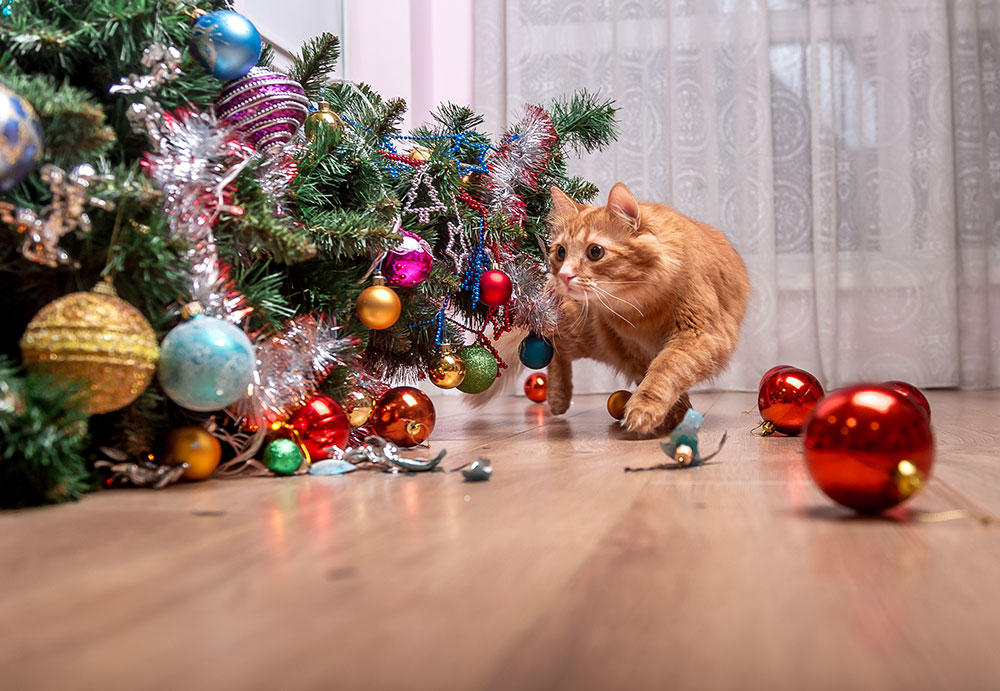
Many people enjoy the natural appearance and crisp, resinous scent of a natural-grown Christmas tree instead of an artificial one. Unfortunately, natural Christmas trees can be dangerous to dogs and cats. Pets are tempted to play with and ingest the fallen needles, which can upset their stomachs or, more seriously, their intestines, neither of which is a situation you want to deal with over the holidays.
Here are some general tips for Christmas tree pet safety, especially if you opt for the natural tree.
1. Try a Pet Gate
Depending on the layout of your house, you may be able to put your Christmas tree in a room where you can see it from the living area and then put up a pet gate to the room so your dog won't be able to come any closer than you want him to. Unfortunately, this is a solution that will only work if you only have dogs in the house; cats can jump over gates that are less than four or five feet tall.
2. Train Your Dog To "Leave It"
Teaching your dog to "leave it" can help keep her out of all sorts of dangerous situations. It can also protect your Christmas tree. If your dog doesn't already know this handy command, start teaching it to her well before Christmas. Offer treats when she does it right to positively reinforce the behavior. Before long, the command will be enough.
Despite what people think, it is not impossible to teach a cat to obey commands. However, cats are more feral than dogs, so it does take a lot more effort. Though few ultimately succeed, there is no harm in trying.
3. Water Your Tree Often
Once you get your tree set up, water it often. Watering the cut tree helps to slow down the rate at which it loses needles, which are one of the main dangers of Christmas trees for pets. Vacuum up the needles as often as possible; at least on a daily basis.
4. Secure Your Tree
If your pet knocks over your Christmas tree, she could be injured or the tree could be damaged. You can decrease the likelihood of your pet tipping your tree over by securing it to a wide, solid, sturdy base. Some people take the extra step of installing a hook or clasp on the wall or ceiling where they place their Christmas tree every year so they can actually fasten their tree to it to keep it upright.
5. Consider a Shorter Tree
Cats have a natural instinct to climb up high where they can watch for prey or escape from predators. In many cases, this leads to them knocking over tall Christmas trees. If you choose a shorter Christmas tree and place it on the ground, your kitties may not consider it worthwhile to try and climb it, especially if they have a taller cat tree they can use.
6. Wait Before You Decorate
Let the tree sit undecorated in your home for a few days before you start decorating. This will give your pets an opportunity to investigate it and get used to its presence before you start adding decorations.
7. Keep the Pets Out of the Room While Decorating
Christmas tree decorations can look like toys to dogs and cats. While you are busy decorating the tree, they may be looking for things to play with. Keep pets out of the room while you are decorating, and when you are finished, put any unused decorations away.
8. Be Careful What You Put On Your Tree
Use only decorations made of unbreakable materials, such as paper, felt, silk, or wood. If your pet gets ahold of one of these, he may destroy the ornament itself but shouldn't get hurt in the process. Don't put tinsel on your tree, it can harm your pet's digestive tract if he accidentally swallows it.
9. Don't Just Tie One On; Tie Them All On
Tie your ornaments onto the tree using ribbons rather than hanging them from metal hooks. There are two reasons for this: Tying ornaments to the tree attaches them more securely, making them less likely to fall off, and avoiding the use of metal hooks helps protect your pet from injury. Just be sure the ribbons are no longer than necessary because it isn't safe for pets to swallow them.
10. Let Your Pet Be the Tree
If all else fails, you can forgo the tree completely. Instead, you can dress your dog up in this adorable Christmas tree costume and let her be the center of the festivities.
11. Exercise Electrical Cord Safety
Dogs and cats like to chew on electrical cords, including those for your Christmas tree lights. This could result in a nasty shock. Tape down loose cords, supervise your pet when he's in the same room as the tree, and unplug the lights when they are not in use. As a bonus, this helps to cut down on your utility bills, which can go up during the holiday season because of the extra lights you are using.
12. Don't Use Edible Decorations
Decorations made of food may attract pets to the tree, which is the opposite of what you want to do. Furthermore, some decorations that are edible for humans, especially anything containing chocolate, are poisonous to pets. Don't put any edible decorations on the tree, including salt-dough ornaments.
Finally, artificial trees are a little bit safer for pets than natural, so consider this as an option if you are ambivalent about a natural tree.