Save 15% on your 1st Autoship learn more

 Email us
 Live Chat
 FAQs
FAQs





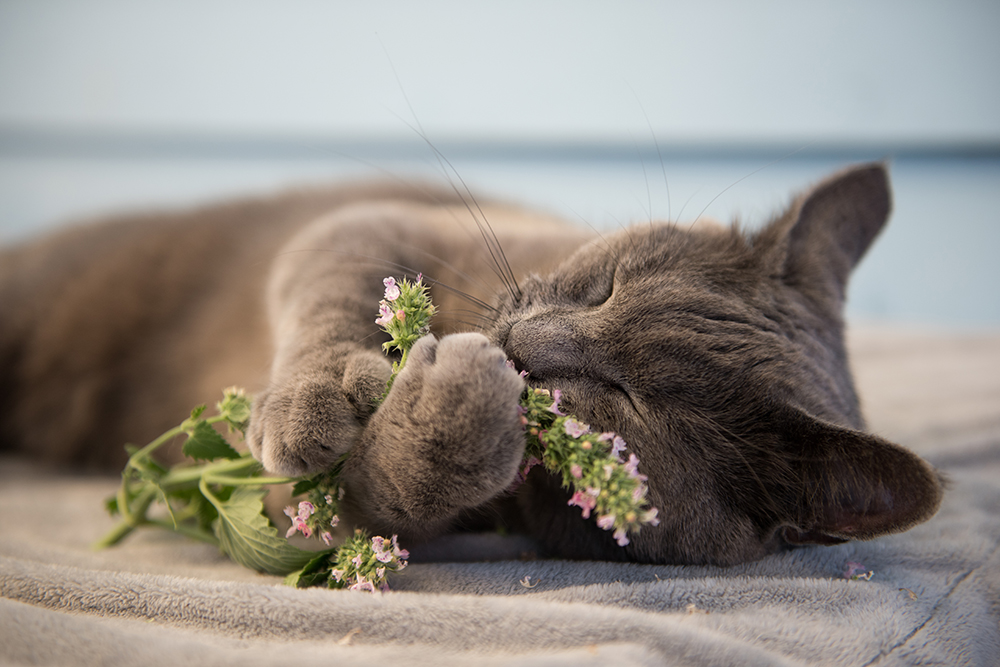
Catnip is an herb that belongs to the mint family and is related to oregano and basil. Its scientific name is nepeta cataria, and it also goes by the names catwort and catmint, as well as field balm. Catnip is known for its lemony, minty aroma, but it is a chemical called nepetalactone that has a mood-altering effect on felines big and small. The reaction is so dramatic that "catnip" has become a colloquialism for something that is so desirable that it brings about changes in behavior.
Approximately 80% of all domestic cats react to catnip, but they do not all react the same way. The effect tends to be mood elevating, but for some cats, that translates to a state of blissful calm while for others, it means playful hyperactivity that can escalate to aggression. Nevertheless, catnip can be beneficial for cats. It is non-toxic, meaning it is safe for them to ingest if they are so inclined. While people sometimes consider it a recreational drug for felines, they cannot overdose on it or become addicted to it. The euphoric effects wear off fairly quickly.
In addition to a special treat, catnip can be a useful tool for helping a cat adjust to a new situation, calming anxiety, and encouraging desired behaviors. Here are some tips for introducing your feline friend to catnip and using it effectively.
1. Wait Until Your Cat Is Older
Research shows that catnip has little to no effect on cats that are very young. Therefore, if you have a new kitten, you should wait to introduce her to catnip until she is fully mature. It probably won't have the effect you want while your cat is still young, and if your cat is overexposed to it at an early age, she may develop a tolerance to it so that it will not affect her when she is old enough to appreciate it.
2. Monitor Your Cat's Reaction
Catnip affects cats in unpredictable ways. If your cat is sensitive to catnip, he may lick it up or roll around in it. He may become calm and even start to drool a little bit. Conversely, he may become more active and start tearing around the house or become more vocal than usual. Some cats become more playful under the influence of catnip. This behavior can edge into aggression, with cats playing more roughly than usual. Your cat's reaction gives you clues as to whether you should use catnip and if so, in what situations. For example, if it has a calming effect, you can use it to prepare him for stressful situations, such as vet visits. If your cat has an aggressive personality at baseline, you should not give him catnip. Chances are, it will just amplify that behavior by removing his inhibitions.
3. Don't Give Too Much Catnip
If you overexpose your pet to catnip, after a while it may not affect her the way it used to. Save it for special occasions. Also, do not give too many doses in short succession. The effects of catnip are short lived, typically wearing off after 15 minutes at most, but once cats come down from it, it takes at least an hour before they react to it again.
Furthermore, if your pet seems uninterested in catnip, it may be that he just does not react biologically to it. If that's the case, don't force the issue.
4. Buy High-Quality Catnip
You can purchase catnip fresh or dried. Fresh catnip tends to have more of an effect than dried catnip. In either case, check that the catnip is potent and contains more leaves and flowers as these structures contain more nepetalactone than the stems. After a while, catnip can lose its natural oils, so store it in an airtight container and consider freezing catnip to preserve it.
5. Use Refillable Catnip Toys
Some toys are sold already containing catnip, but they may use plants of low quality that may not be potent enough to have an effect on your cat. When you buy refillable catnip toys, you know that they are filled with high-quality plants. You also control the amount of catnip that goes into them. Whether you use refillable or pre-filled catnip toys, rotate them in and out periodically so that your cat does not become overexposed to nepetalactone and develop a tolerance to it.
You don't necessarily have to buy catnip toys at all. You can also make your own by filling an old sock with high-quality catnip and knotting it at the top.
6. Use Catnip as a Training Aid
You can use catnip to encourage behaviors that you want in your cat. For example, it can be very difficult to encourage a kitty to scratch on a scratching post rather than on the furniture. Rub some catnip on the scratching post to redirect her attention and reward her for her interest.
Research shows that positive reinforcement is the most effective form of behavior modification for pets. When your cat does something especially good, you can use catnip as a reward in lieu of food treats. This may be a good strategy if your cat has a weight problem and you are trying to get him to slim down.
7. Grow Your Own Catnip
Growing your own catnip as a potted plant not only means that you'll always have a fresh supply, it may distract your cats from your other houseplants, which she might otherwise destroy.
If you use it correctly, catnip can be beneficial for both you and your pet.