
 Save 15% on your 1st Autoship learn more

 Email us
 Live Chat
 FAQs
FAQs





The winter months can wreak havoc on your activity levels. In the colder season, it might be harder to get out and do more things. If your dog is your normal partner, then you may think you have to put off walks and playtime because of the dropping temperatures. This is not the case.
January is a month for your pets. With National Dress Up Your Pet day on the way and Change a Pet’s Life Day, it makes sense to celebrate your pooch. Here are some ideas to stay active in the winter.
Inside Games
You do not have to go outside to exercise with your dog. Being indoors gives you plenty of opportunities to get moving.
There’s no reason that you have to go outdoors to play fetch. Keep the game inside. You can play fetch in a long hallway or in your most spacious room. Just find your dog’s favorite toy or ball and toss it. Remember to remove any valuables that might fall over beforehand!
Another idea is to build an indoor agility course. Use broomsticks, blankets, chairs and hula hoops to create an obstacle course. It can be a fun exercise for both of you. Train your dog to navigate the course and avoid the winter weather.
If you have stairs in your home, you and your dog could run stairs together. A great exercise for humans and dogs is to take laps up and down to get your heartrate up. Dogs love to run and to climb. Also, if you don’t want to climb stairs yourself, you could integrate a game of fetch instead.
There are no limits to the types of games that you can play with your dog. Try to think about your outdoor activities and try to adjust those activities to indoor ones. Staying active is important for both of you in the colder months.
Puzzle Toys
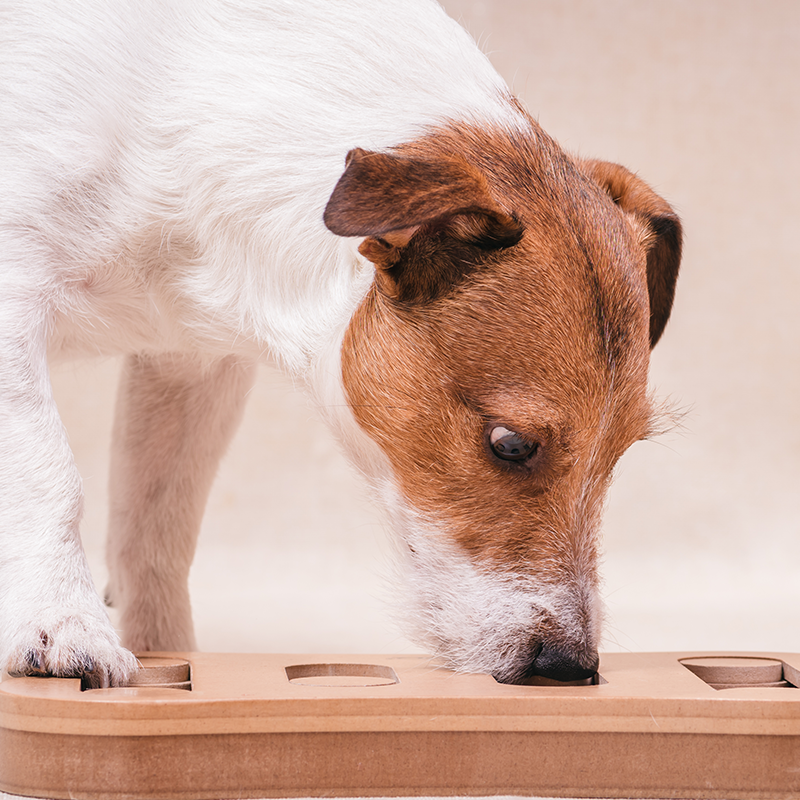
Every dog owner knows a dog’s love for food! Dogs spend more time indoors in the winter and due to this, they often receive less mental stimulation. Why not turn feeding time into a game? A little mental challenge can be as tiring as a physical challenge.
Start with slow feeders. These dishes may look like mazes on the inside. This forces the dog to slow down and remain engaged with the feeding process. In addition to mental stimulation, this can also be a healthier way to feed your dog. Some dogs eat too fast and won’t chew the food. This can lead to digestive issues and stomach upset. Slow feeders force the dog to eat slowly.
Treat dispensing toys are also a fun way to engage your dog. Try out a Kong full of treats. The dog will have to work to find the treat inside. Likewise, there are cubes in which a dog will have to roll and turn to dispense the treats or kibble. Simpler routes include hiding the treats around the house. Challenge your dog to seek out the treats.
Outside Walks
Winter is in full swing. Too many dog owners believe that this marks the end of walking season. Instead of walks, you keep your dog inside and only let it out for bathroom breaks. Some dogs may not react poorly to being indoors. Lazier dogs may nap next to the fire all winter long. Should you let your dog hibernate all winter? The answer is probably not.
Walks provide a solid foundation for mental and physical health. For higher energy dogs, walks are a necessity each day. Without a daily walk, a dog may become bored and restless. When restless, dogs may become more prone to destructive behavior. Instead of allowing your dog to wreak havoc on your home, continue those daily walks.
The walks may have to be shorter in the winter months. You can liven up the shorter walks by choosing new routes. Cooped up dogs don’t have a lot of mental stimulation. If you take the same walk every day, they may still exhibit restless behavior. You can drive to a new part of town with your dog, then take a walk in a new area. If you and your dog are familiar with walking trails, try to take trails that you don’t normally take. Remember that shorter walks may be necessary, but you don’t have to make them boring.
Pay close attention to your dog’s temperature tolerance. Dogs won’t be able to tell you when it’s too cold. Instead, you have to know the signs. Signs include:
-
Shivering and shaking
-
Whining and barking
-
Lifting paws
-
Changing of behavior
-
Showing anxiety or fear
-
Seeking shelter
-
Hunching posture
Dogs may try to go back inside or stiffen up when too cold. For dogs that cannot handle the cold, you do not have to leave them inside all winter. Do what you do when it’s too cold outside. Dress your dog up!
There is a wide assortment of winter clothes for dogs! Clothes include:
Winter sweaters
-
Raincoats
-
Fleece-lined jackets
-
Waterproof boots
-
Snow boots
The options come in different sizes for different body shapes. For dogs with a denser coat, you may need a thinner jacket to protect against the elements. Shorthaired dogs may require heavier, fleece lined jackets.
Major considerations when buying dog clothes are the sizes, the level of warmth and also the hardware and design elements. For instance, you do not want any buckles or straps that may irritate your dog. You want your dog to be comfortable and warm. This means that the clothes should always be an appropriate fit.
Winter weather does not have to put an end to your activities. While you can still take walks with the right winter weather, you can also plan to do more activities in your home. A bored dog is a restless dog. When dogs become bored, they may take their boredom out on your home. To keep your dog active, you can create new indoor games and puzzles. Additionally, you can find the right winter clothes for your pup to enjoy the great outdoors again.






