Save 15% on your 1st Autoship learn more

 Email us
 Live Chat
 FAQs
FAQs





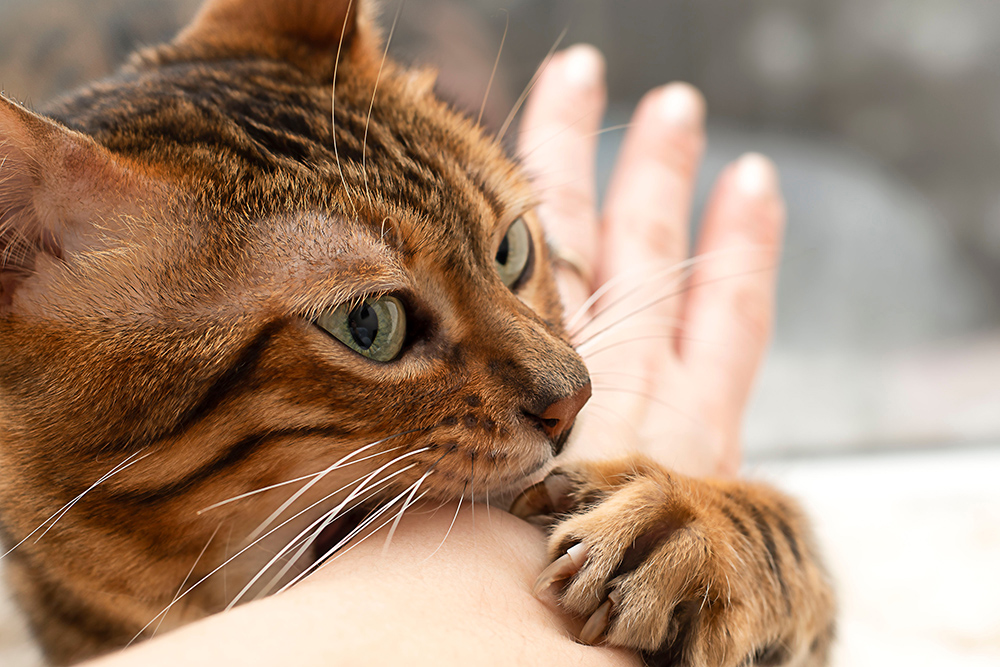
Some people think it's cute and funny when a kitten bites, but this is a behavior you should seriously try to discourage. Kittens may not be able to do much harm by biting, but adult cats may bite hard enough to break the skin. Cats' needle-like teeth can inject pathogens deep into the tissue, and infection can result. Regardless of how old your cat is, you can teach her not to bite.
Why Do Cats Bite?
Finding out why your cat is biting is the first step to stopping it. Kittens and adult cats may bite for many different reasons. Biting is instinctual play behavior from kittens. They know they've gone too far when their mother or siblings react negatively by hissing or withdrawing. Kittens that are removed from their litters too early may not receive this necessary instruction. They keep biting because they never learned not to. Much like human babies, kittens also bite to relieve teething discomfort.
A cat that never learned that biting is unacceptable as a kitten, and that might have been actively encouraged in the behavior when it was cute and seemed harmless, will probably continue to do so as an adult. Both kittens and adult cats may bite because something triggered their predatory instincts.
If an adult cat that wasn't prone to biting suddenly starts, there could be several different reasons behind it:
• Pain or Sickness: If your cat is sick or hurt, petting him may cause pain. He may bite to get you to stop hurting him, even though you do not realize that is what you are doing.
• Overstimulation: Cats are acutely sensitive to touch. If you pet them too long or in the wrong places, they can become overstimulated. This can be alarming — the cat seems to be enjoying your caresses, then all of a sudden she turns on you for seemingly no reason — but it is a normal reaction.
• Stress: Loud noises, invasive handling, and other unfamiliar situations can cause cats fear and stress. Even an otherwise docile cat may lash out in a stressful situation.
Cats live in complicated social hierarchies. If your cat is biting you, it may be that he is trying to assert dominance over you and the rest of the household. Human-feline communication can be tricky, and cats may bite to get your attention or let you know they want something. They can also bite out of frustration when they want something they can't have, such as a bird or squirrel sitting outside the window.
How Can You Stop Cats From Biting?
The following eight steps can help you determine why your cat is biting and put a stop to it:
1. Take your cat to see a veterinarian. Have a full examination done to rule out any physical problem that could be causing your cat to bite.
2. Don't reward your cat for biting. If he is biting you because he wants food, don't give it to him until he calms down. If he is biting you for attention, ignore him completely for 30 seconds to a minute. If he is biting hard enough to hurt or won't let up, leave the room and go someplace he can't follow. He'll probably stop biting once he realizes that it doesn't get him what he wants.
3. Make it clear to your cat that your hands are not toys. Don't ever tease her with your fingers or encourage her to chase your hands. Give her toys that she can bite and chew on all she likes and redirect her behavior into acceptable channels.
4. Keep your response to your cat's biting consistent. You can hiss or say "no" in a firm but calm voice, but make sure everyone in the household does the same thing. Don't try to punish your cat physically for biting. He may think you are playing or become scared. In either case, he is more likely to keep biting.
5. The difficulties in human-feline communication go both ways. Learn about cats' body language to understand the message that your pet is trying to send you. For example, many people misinterpret a cat's twitching tail as happiness because that is what it means for dogs. However, a cat wags its tail when annoyed. Similarly, an angry cat puts its ears back and arches its spine. These are signs that a cat uses to let you know that she is about to bite.
6. Respect your cat's boundaries. Even the most affectionate cat needs to retreat to be by himself sometimes. Don't invade your cat's space and don't handle him in a way he doesn't like. For example — and again, unlike dogs — most cats don't like to have their tummies rubbed. If your cat accepts this behavior, you can proceed, but if not, stop doing it.
7. There are times when you have to handle your cat in a way she might not like, such as when you are trimming her nails or brushing her teeth. Introduce these behaviors gradually to be non-threatening and teach her to accept them by rewarding her with treats for staying calm and cooperative.
8. Positive reinforcement is more effective than punishment, but it can be difficult to reward your cat for NOT doing something. Look for opportunities to reward your cat for good behavior and try different types of rewards, such as catnip.
If possible, it is best to teach cats not to bite as kittens. Fortunately, with patience and consistency, even an older cat can learn good manners and acceptable behaviors.