
 Save 15% on your 1st Autoship learn more

 Email us
 Live Chat
 FAQs
FAQs





Introduction
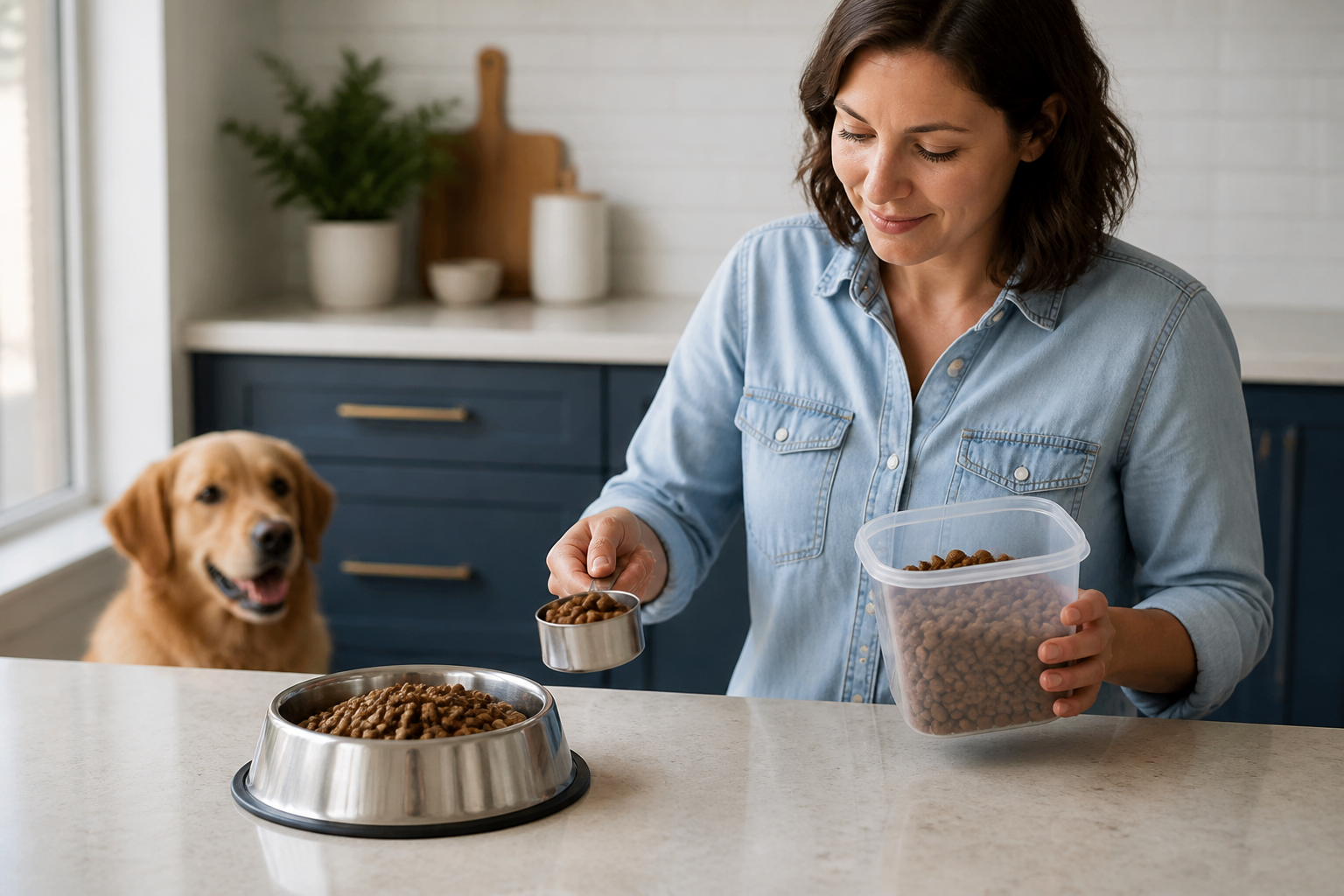
You reach for the dog food bag, plastic scoop in hand, and eyeball the "one cup" line for the third time today. Your dog sits nearby, tail thumping, waiting for the familiar sound of kibble hitting the ceramic bowl. It seems like a simple task. However, that plastic scoop might be the reason your dog is slowly gaining weight or isn't getting quite enough nutrients. At BaxterBoo, we see this confusion often because a "cup" of food can mean many different things depending on the brand, the kibble size, and even the shape of the measuring tool.
This post covers why the standard measuring cup is often inaccurate for dry goods and how density affects your dog’s daily intake. We will also provide practical steps to ensure you are feeding the right amount every single time. Our goal is to help you move beyond the guesswork so your dog stays at a healthy weight.
Quick Answer: A standard measuring cup typically holds about 3 to 5 ounces of dry dog food by weight, but this varies wildly. Because kibble density and shape differ between brands, the only way to be 100 percent accurate is to weigh the food in grams or ounces using a digital scale.
The Mystery of the Measuring Cup
The word "cup" is one of the most misunderstood terms in the pet food world. Most people grab a standard liquid measuring cup from their kitchen drawer. These cups are designed to measure 8 fluid ounces of water or milk. This does not translate directly to dry matter like kibble.
When you measure a liquid, there are no air pockets. When you measure kibble, the spaces between the individual pieces create gaps. These gaps mean a cup of small, round kibble weighs much more than a cup of large, star-shaped kibble. If the bag says to feed two cups, and you use a rounded kitchen scoop, you could easily be overfeeding by 20 percent or more.
Liquid Ounces versus Dry Weight
A common mistake is assuming that 8 ounces of volume equals 8 ounces of weight. In the world of baking and science, weight and volume are two very different things. A "cup" of lead weighs more than a "cup" of feathers, even though they take up the same amount of space.
Dry dog food follows this same rule. Some high-protein, air-dried foods like Ziwi Peak are extremely dense. A small scoop of that food contains far more calories than a large scoop of a "light" or weight-management kibble. If you switch brands but keep using the same measuring cup, you might accidentally double your dog's caloric intake without realizing it.
Key Takeaway: Using a liquid measuring cup for dry kibble is the primary cause of unintentional overfeeding. Volume measurements do not account for the air pockets between pieces of food.
Why Kibble Shape and Size Matter
If you look at different brands like Royal Canin or Farmina, you will notice the kibble shapes vary significantly. Some are flat discs, others are small spheres, and some are large, chunky squares. These shapes do not "settle" in a measuring cup the same way.
Small kibble pieces pack tightly together. They leave very little room for air. This makes the cup heavier. Large kibble pieces are awkward and leave large gaps in the cup. This makes the cup lighter. If you fill a cup to the brim with large kibble, you are actually feeding less food by weight than if you filled it with small kibble.
The Packing Effect
The way you scoop the food also changes how much ends up in the bowl. If you dip the cup into the bag and pack it down, you are fitting more kibble into the space. If you gently pour the food into the cup, it will be looser and lighter.
Studies have shown that even veterinary professionals struggle to measure a "cup" of food consistently. Some people "level off" the top with a knife, while others "heap" the food. These small habits add up over weeks and months. Over a year, an extra 10 percent of food per meal can lead to significant weight gain for a small or medium-sized dog.
Reading the Label for Clarity
The Association of American Feed Control Officials (AAFCO) sets the standards for pet food labels. However, these labels can still be vague. You might see a guideline that says to feed a 40- to 60-pound dog 1 to 2 cups daily.
This range is very wide. A 40-pound dog has very different caloric needs than a 60-pound dog. Furthermore, "1 to 2 cups" leaves a lot of room for error. Does that mean 1.25 cups? 1.5 cups? Most owners see the larger number and gravitate toward it because they want their dog to feel full.
Finding the Calorie Density
To truly understand how much is in a cup, you have to look for the "calorie content" statement. This is usually listed as kcal/kg (kilocalories per kilogram). It might also list the calories per cup.
If a food has 4,000 kcal/kg, it is very calorie-dense. If it has 3,000 kcal/kg, your dog can eat more volume for the same amount of energy. We carry brands across this entire spectrum at BaxterBoo, from high-energy working dog formulas to low-calorie senior diets.
Vet Tip: Always look at the calorie count (kcal) per cup rather than just the "cups per day" chart. Your veterinarian can help you determine exactly how many calories your dog needs based on their current weight and body condition score.
The Digital Scale Solution
The most accurate way to measure dog food is by weight, not volume. This is why many high-quality brands are now including gram measurements on their packaging. A gram is always a gram, regardless of the kibble shape or how much air is in the bag.
Using a digital kitchen scale removes all the guesswork. You can place the bowl on the scale, hit the "tare" or "zero" button, and pour until you reach the exact number. This ensures that every meal is identical. It is especially important for dogs with health conditions like diabetes or kidney disease where consistency is vital.
How to Switch to Weighing
- Find the kcal/kg on your dog food bag.
- Determine how many calories your dog needs per day.
- Calculate the grams needed (or call the manufacturer to ask for the weight of one cup in grams).
- Place your dog's bowl on a digital scale and zero it out.
- Pour the kibble until you reach the target weight.
Bottom line: A digital scale is the only way to guarantee your dog receives the exact amount of nutrition intended by the manufacturer.
Calculating the Calories
If your dog food bag only provides kcal/kg, you can do some simple math to find the calories per ounce. There are 35.27 ounces in a kilogram.
If your food has 3,500 kcal/kg:
3,500 / 35.27 = 99.2 kcal per ounce.
If your vet says your dog needs 600 calories a day:
600 / 99.2 = 6.04 ounces of food per day.
This is much more precise than trying to figure out what "three-quarters of a cup" looks like in a plastic scoop. For additional guidance, see our guide to measuring dry dog food in grams.
Why Precision Matters for Small Dogs
For a Great Dane, an extra half-cup of food might not make a visible difference in their weight for a long time. For a ten-pound Chihuahua, an extra tablespoon of food is a massive percentage of their daily intake. Small and toy breeds are at the highest risk for obesity caused by measuring errors. Even a few extra kibbles every day can lead to joint stress and heart issues in smaller animals.
Managing Weight Through Proper Portions
Obesity is one of the most common health problems in dogs today. It often leads to secondary issues like arthritis, skin infections, and a shortened lifespan. Most owners do not realize their dog is overweight because the change happens slowly.
If your vet has recommended a weight loss plan, the first step is always fixing the measurement process. We often recommend moving to a prescription weight management diet for dogs that struggle to lose weight on standard kibble. Our pet pharmacy carries prescription pet foods through our partnership with Pet's Choice. These diets are formulated to help dogs feel full while consuming fewer calories, but they still require precise measuring to work effectively.
Signs You Are Overfeeding
- You can no longer feel your dog's ribs without pressing hard.
- Your dog has lost their "waist" when viewed from above.
- Your dog’s stomach hangs down when viewed from the side.
- Your dog has become less active or tires easily on walks.
Key Takeaway: Feeding by weight rather than by the "cup" is the most effective tool for weight management and preventing obesity-related health problems.
Dealing with Canned Food Measurements
Measuring wet or canned food presents a different challenge. Most cans list the total calories per can. If your dog needs a portion of a can, it is easy to get it wrong by just scooping it out with a spoon.
Just like with dry food, weighing wet food is the best approach. You can calculate the calories per gram by dividing the total calories in the can by the net weight in grams. This allows you to be precise even when mixing wet and dry food together. For more guidance, read our guide to mixing wet and dry dog food.
Step-by-Step: Mixing Wet and Dry
Step 1: Calculate the daily calorie goal. / Work with your vet to find the total number of calories your dog needs.
Step 2: Decide the ratio. / Determine how many calories will come from dry food and how many from wet.
Step 3: Weigh the dry portion. / Use your scale to measure the kibble in grams.
Step 4: Weigh the wet portion. / Add the wet food to the bowl until the scale reaches the combined target weight.
The Role of Treats in the "Cup" Equation
When people ask how much is in a cup of dog food, they are often trying to balance the total daily diet. However, they frequently forget to account for treats. If you are feeding exactly the right amount of kibble but giving several large biscuits or dental chews, the "cup" measurement is no longer accurate for their health needs.
Treats should never make up more than 10 percent of your dog's daily caloric intake. If you give a high-calorie treat, you must subtract those calories from their meals. This is another reason why knowing the exact calories in your measuring cup is so important. It allows you to make adjustments throughout the day.
Using Proper Tools
If you are not ready to use a digital scale, the next best thing is a dedicated pet food scoop with clear, embossed lines. Avoid using random containers like coffee cans, yogurt tubs, or plastic drinking cups. These items do not have standard measurements and lead to massive inconsistencies.
Features of a Good Scoop
- Clear markings for 1/4, 1/2, and 3/4 cups.
- A flat edge for leveling off the food.
- Durable, BPA-free plastic or stainless steel.
- A handle that allows you to reach the bottom of the bag without crushing the kibble.
Note: Even the best scoop is still a volume measurement. Use it as a backup or a quick tool, but try to verify the weight of that "scoop" on a scale at least once a week to stay on track.
Common Obstacles to Accurate Feeding
Many households have more than one person feeding the dog. If Mom uses a "heaping" cup and Dad uses a "level" cup, the dog is getting a different amount of food every time. This inconsistency can make it very hard to diagnose why a dog is gaining weight or having digestive issues.
We suggest using a single, dedicated measuring tool and keeping it inside the food container. Better yet, write the weight in grams on a piece of masking tape and stick it to the lid of the food bin. This way, whoever is on feeding duty knows exactly what the goal is.
Consistency Across Caregivers
- Use one dedicated scoop or scale.
- Post a feeding chart on the fridge with the exact weight in grams.
- If using a scale, ensure everyone knows how to "tare" the bowl.
- Use a whiteboard to check off when the dog has been fed to avoid double-feeding.
Adjusting for Life Stages
The "cup" of food your dog needs will change as they age. A growing puppy needs a much higher caloric density than an older dog who spends most of the day napping. When you transition from puppy food to adult food, the calories per cup will change.
You cannot simply give the same number of cups of the new food. You must look at the label, compare the kcal/kg, and recalculate the weight. This is a common time for dogs to gain weight rapidly. Owners often switch to adult food but continue using their "puppy-sized" scoop.
Activity Levels and the Environment
Outdoor dogs in cold climates may need more calories in the winter to maintain their body temperature. Highly active dogs, like those doing agility or long hikes, will also require more than the "average" amount listed on the bag. Conversely, if your dog is recovering from surgery or is less active during a rainy week, you should slightly reduce the amount in their cup.
Vet Tip: If your dog's activity level changes significantly, do not just guess the new food amount. Re-evaluate their body condition score every two weeks and adjust the grams of food by 5 to 10 percent until their weight stabilizes.
How BaxterBoo Can Help
Maintaining your dog's health starts in the bowl. We carry over 500 trusted brands, including premium options like The Honest Kitchen, Stella and Chewy’s, and NutriSource. Whether you need a high-protein kibble or a specialized senior diet, our selection is handpicked by people who understand the nuances of pet nutrition.
For those managing chronic conditions that require more than just standard kibble, our pharmacy offers a wide range of prescription diets and medications. Through our partnership with Pet's Choice, we provide access to FDA-approved options for weight management, kidney health, and allergy relief. Accurate measuring is the foundation of these treatments, and we are here to provide the tools and the food to make it happen.
Conclusion
Understanding how much is in a cup of dry dog food is the first step toward better health for your pet. While volume measurements are convenient, they are rarely accurate enough for long-term weight management. By switching to a digital scale and measuring by weight, you can eliminate the variables of kibble shape, size, and air pockets.
- Stop using liquid measuring cups for dry kibble.
- Check the kcal/kg on your bag to find the true calorie density.
- Use a digital scale to measure food in grams or ounces.
- Account for treats within the daily calorie limit.
- Consult your vet if you notice your dog’s body condition changing.
To keep your feeding routine consistent and save money, consider signing up for our Autoship program. You can get your favorite food delivered on a schedule that works for you, ensuring you never run out or have to rush to the store. Plus, you will earn points through the MVP Rewards program on every purchase.
FAQ
Is a dog food scoop the same as a measuring cup?
Most dog food scoops are designed to mimic a standard 8-ounce liquid measuring cup, but they are not always calibrated perfectly. Because they are often made of molded plastic, the lines may not be as accurate as a glass kitchen measuring cup. For the best results, you should verify how many grams your specific scoop holds by using a digital scale.
Why does the feeding chart on the bag give such a big range?
Feeding charts are general guidelines based on an average dog's weight, but they cannot account for your dog's individual metabolism, age, or activity level. A lazy bulldog and an active border collie of the same weight have very different energy needs. Manufacturers provide a range so you can start in the middle and adjust based on your dog’s body condition.
How many grams are usually in a cup of dry dog food?
On average, a cup of dry dog food weighs between 90 and 120 grams, but this varies significantly between brands. High-density foods or air-dried options may weigh much more per cup, while "light" kibbles with more fiber may weigh less. Always check the bag or contact the manufacturer to find the specific gram-to-cup ratio for your chosen formula.
Can I just use a coffee mug to measure my dog's food?
You should avoid using coffee mugs or random kitchen containers because they do not have a standard volume. A coffee mug can hold anywhere from 8 to 14 ounces, which makes it impossible to follow the feeding guidelines on the dog food bag. If you do not have a scale, use a standardized measuring cup specifically designed for dry ingredients.






