Save 15% on your 1st Autoship learn more

 Email us
 Live Chat
 FAQs
FAQs





Written by: Dr. Primrose Moss MA VetMB MRCVS
From your dog’s daily meals to their training treats, picking the right type of food for your dog can be overwhelming. In this article we’ll take a deep dive into freeze-dried vs dehydrated dog food, including the differences between them and the pros and cons to help you decide which is right for your dog.
What’s the difference between freeze-dried and dehydrated dog food?
Dehydration has been used to preserve foods for thousands of years – though the process has moved on a bit in that time.
Foods are gently heated, typically to between 140ËšF and 180ËšF, and warm air is used to remove moisture. The low temperature is intended to help preserve foods’ nutritional value and is much gentler than typical cooking processes.
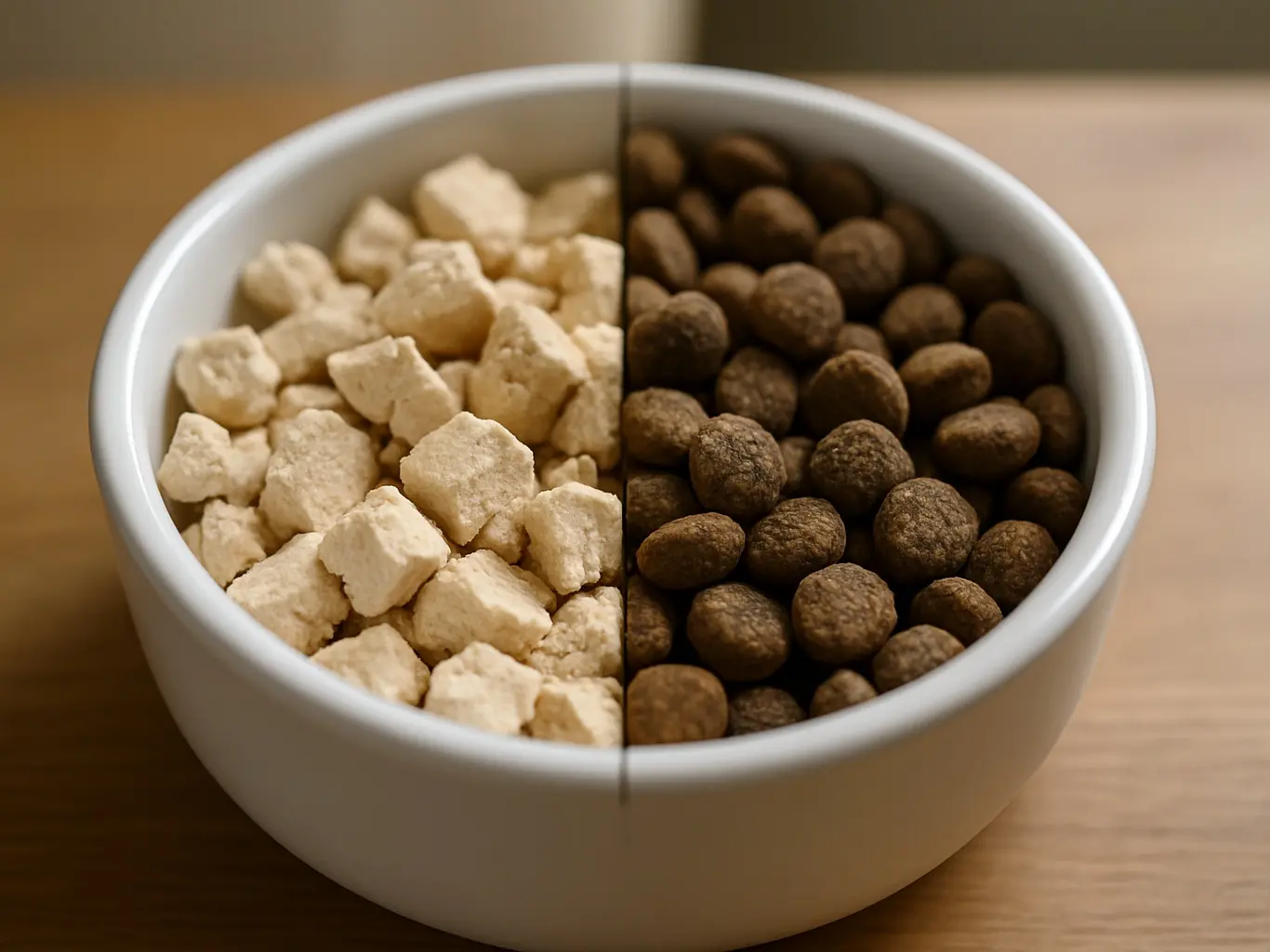
So, what’s the difference between freeze-dried and dehydrated dog food?
Freeze-drying also isn’t an entirely new invention – records suggest it might have been used as early as the 13th century – but it’s only been widely used in the last few decades.
It’s a specific type of dehydration which involves freezing food, then reducing the air pressure surrounding it to allow the frozen water in the food to sublimate – turning directly from ice into water vapour, without melting. The water vapour is removed under vacuum. Very gentle heating may then be used to remove any remaining water. This process is even gentler than conventional dehydration, and can be more effective at removing water from foods.
While there are some clear differences between freeze-dried and dehydrated dog food, the two processes aren’t dissimilar.
Both dehydrated and freeze-dried dog food are often, but not always, raw. While some people consider the gentle heating involved in dehydration as cooking, both options are typically deemed raw unless the food is cooked prior to drying. This is because the temperatures used aren’t high enough to cook the food and eliminate bacteria.
Both dehydration and freeze-drying remove enough moisture to significantly limit the growth of any bacteria, molds, yeast or fungi that are present. This allows the food to remain preserved for long periods if stored appropriately, frequently without the addition of any preservatives.
What are the pros and cons of dehydrated dog food?
You know how it’s produced, but what are the benefits of dehydrated dog food – and are there any downsides?
Benefits of dehydrated dog food:
- Dehydration can be an effective method of preservation, extending food’s shelf life and making it lightweight and easy to store
- Dehydration doesn’t degrade nutrients such as heat-sensitive vitamins as much as a high-temperature cooking or extrusion process can
- Dehydrated foods can be rehydrated easily – typically in 5-10 minutes
- Dehydrated dog food is often more affordable than freeze-dried options
Drawbacks of dehydrated dog food:
- It can have a less appetising appearance than freeze-dried food
- Gentle heating may degrade some heat-sensitive nutrients and enzymes more than freeze-drying
- Raw dehydrated foods may carry bacteria and parasites, which can affect dogs and humans
Dehydration can be an effective way of preserving dog food without added preservatives, and has the advantage of often being more affordable than freeze-dried options. If you pick a raw dehydrated diet, it’s important to consider your dog’s specific needs and lifestyle and balance the benefits against the potential risks to choose the right diet for them.
What are the pros and cons of freeze-dried dog food?
What about the pros and cons of freeze-dried dog food? There’s some overlap with the list above, but also a few differences when looking at freeze-dried vs dehydrated dog food.
Pros of freeze-dried dog food:
- Freeze-drying is even gentler than dehydrating as it doesn’t involve significant heating – so it leaves more of the food’s natural enzymes intact and can lock in nutrients more effectively
- It rehydrates even more quickly, typically in 2-3 minutes
- Freeze-drying removes more moisture than dehydration – often around 98-99% vs 90-95% – helping to preserve food even more effectively
- The food retains its shape, appearance, smell and flavor more effectively
Cons of freeze-dried dog food:
- It can be more expensive than dehydrated diets as freeze-drying is a relatively costly process
- Raw freeze-dried foods may also carry bacteria and parasites capable of affecting dogs and humans
Overall, freeze-drying can be a great way of locking in nutrients and preserving dog food without added preservatives. As with any diet, it’s important to consider both the benefits and potential downsides when picking the best diet for your dog.
Is freeze-dried or dehydrated food better for dogs?
When it comes to freeze-dried vs dehydrated dog food, there isn’t a single overall winner.
Freeze-dried foods can be more palatable for some fussy eaters and may lock in certain nutrients more effectively – but conventionally dehydrated foods can still offer a great combination of tastiness and nutrient density, can sit at a more affordable price point and are more often gently cooked, helping to eliminate bacteria.
Both options help to lock in nutrients, including natural enzymes and heat-sensitive vitamins such as B vitamins that might otherwise be degraded, although freeze-drying may be more effective than conventional dehydration for this.
One last thing to consider
Before deciding between a freeze-dried or dehydrated diet, there’s one last important point to consider. Both freeze-drying and dehydration can reduce bacterial numbers, typically more than standard freezing, but infectious bacteria can survive with both methods.1-4 Some dehydrated and freeze-dried foods are cooked beforehand, but many aren’t, so it’s important to consider this when picking your dog’s diet.
If you’re concerned about infection, your dog is at higher risk due to immunosuppression or underlying disease, or your household includes young children, the elderly or the immunocompromised,1,4 a carefully cooked diet that’s dehydrated or freeze-dried afterwards may be the best option. Dehydrated diets are typically more likely to be cooked than freeze-dried foods, but it’s worth checking individual products.
Rehydrating and gently cooking a suitable dehydrated or freeze-dried raw food could also work – but this may reduce the levels of some heat-sensitive vitamins.
Freeze-dried vs dehydrated dog food: which is right for you?
There’s a lot more to picking a diet than simply deciding between freeze-dried and dehydrated food. That said, the best choice between these two options is likely to depend on the specific ingredients and formulation of the diets you’re comparing, your budget, and potentially how picky your dog is – a fussy eater will often choose their own diet!
Not sure what else to look for in a diet or how to make a change? Check out our other articles comparing freeze-dried food and dry kibble, looking at the benefits of human-grade food, and discussing how to switch your dog’s food.
References
- Freeman LM, Chandler ML, Hamper BA, Weeth LP. Current knowledge about the risks and benefits of raw meat-based diets for dogs and cats. J Am Vet Med Assoc. 2013;243(11):1549-1558. doi:10.2460/javma.243.11.1549
- Waturangi DE, Amadeus S, Kelvianto YE. Survival of enteroaggregative Escherichia coli and Vibrio cholerae in frozen and chilled foods. J Infect Dev Ctries. 2015;9(8):837-843. doi:10.3855/jidc.6626
- Jiao R, Gao J, Zhang X, et al. Short communication: Effects of vacuum freeze-drying on inactivation of Cronobacter sakazakii ATCC29544 in liquid media with different initial inoculum levels. J Dairy Sci. 2017;100(3):1674-1678. doi:10.3168/jds.2016-11937
- Chitrakar B, Zhang M, Adhikari B. Dehydrated foods: Are they microbiologically safe?. Crit Rev Food Sci Nutr. 2019;59(17):2734-2745. doi:10.1080/10408398.2018.1466265