
 Save 15% on your 1st Autoship learn more

 Email us
 Live Chat
 FAQs
FAQs





Introduction
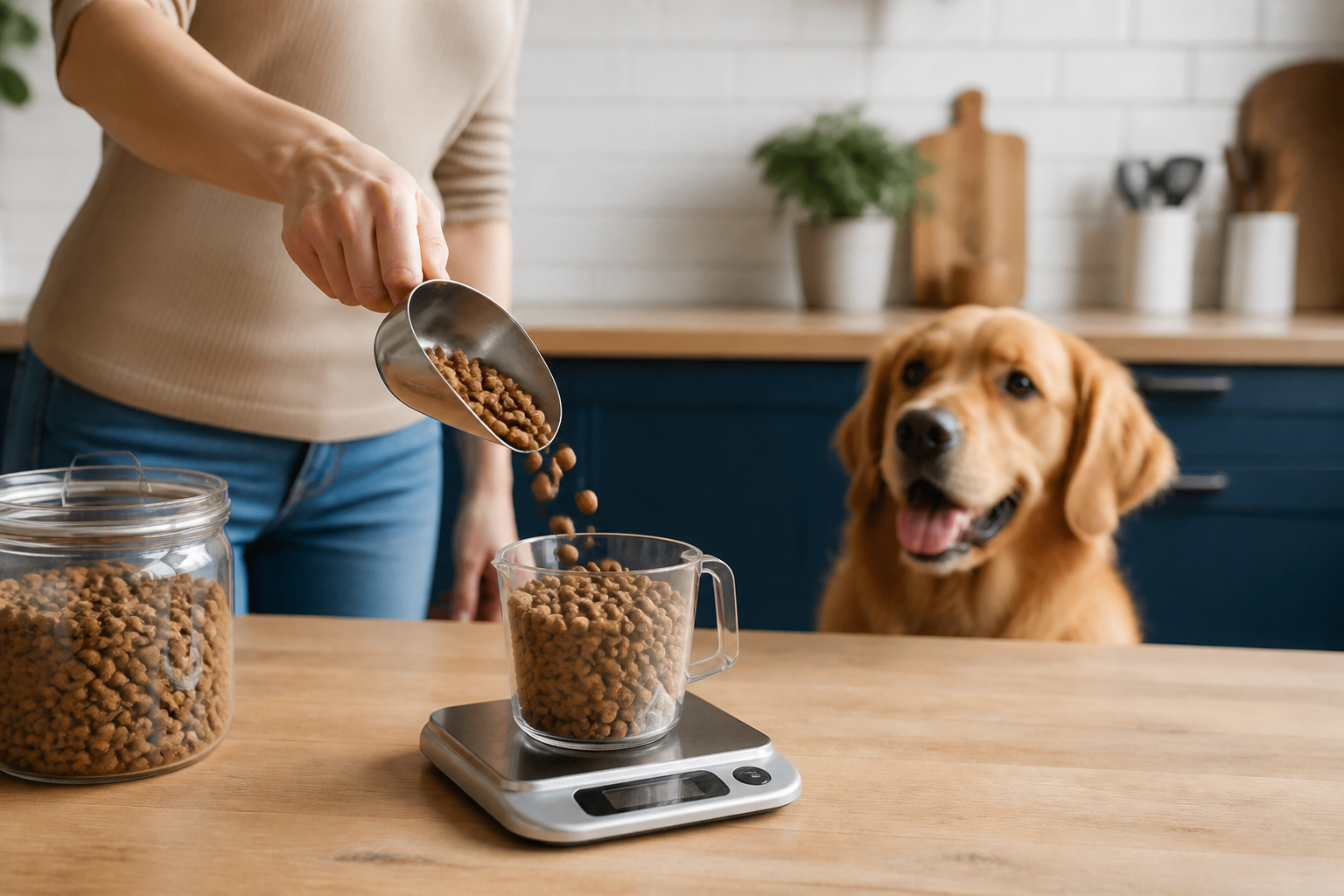
It is 6:00 PM and your dog is already staring at the food bin. You reach for the plastic scoop, level off what looks like a cup, and drop it into the bowl. To you, it looks like the perfect portion. To your dog, it is the best moment of the day. But if you measured that same scoop on a digital scale, you might be surprised by what you see. A single cup of dry dog food can vary significantly in weight depending on the brand, the shape of the kibble, and even how hard you pack the scoop. At BaxterBoo, we talk to pet owners every day who are frustrated that their dogs are gaining weight despite following the bag instructions. This guide will explain why volume measurements are often inaccurate and how to find the exact gram weight for your specific dog food. Using weight rather than volume is the most effective way to keep your dog at a healthy size.
Quick Answer: A standard 8-ounce measuring cup typically holds between 100 and 120 grams of dry dog food. However, this weight changes based on kibble density and size, so you should always check the specific calorie information on your bag.
The Problem With Measuring by Volume
Most pet owners use a plastic cup or a coffee mug to measure out meals. We often think of a cup as a universal unit of measurement, but in the world of dry kibble, volume is a deceptive metric. A cup is a measure of how much space something takes up, not how much it weighs. Imagine filling a cup with lead weights and another with feathers. Both occupy the same amount of space, but their weight and energy density are completely different.
Kibble comes in thousands of different shapes and sizes. Some are small, round pellets while others are large, airy X-shapes or flat discs. These shapes create different amounts of air pockets in your measuring cup. A cup filled with tiny, dense kibble will weigh much more than a cup filled with large, porous kibble. This difference can lead to a significant discrepancy in the number of calories you are actually feeding your dog. If you are comparing formulas, explore our dog food category to see how options can vary.
Research has shown that pet owners are often inconsistent when using scoops. A study from the University of Guelph found that dog owners could be off by as much as 152 percent when trying to measure a standard portion. Some participants underfed their dogs, while a much larger portion overfed them by mistake. This happens because "one cup" means something different to everyone. Some people scoop a "heaping" cup, while others do a "loose" cup. Even the humidity in your kitchen can slightly change how kibble sits in a container.
Why Grams Matter for Your Dog's Health
If you are off by just 10 or 20 grams every meal, it might not look like much in the bowl. However, those extra grams add up quickly over the course of a week, a month, and a year. For a small dog, an extra 20 grams of food per day could represent a 20 percent increase in their total daily calorie intake. This is the primary reason why many dogs struggle with weight management even when their owners believe they are being careful.
Obesity in dogs is a growing concern that leads to serious health issues. Extra weight puts unnecessary strain on joints, which can lead to mobility problems and arthritis. It also increases the risk of heart disease and respiratory issues. By switching to measuring in grams, you eliminate the guesswork. You ensure that your dog receives the exact amount of energy they need to thrive without the risk of accidental overfeeding. For additional portion-planning guidance, read our guide to pet weight management.
We recommend using a simple digital kitchen scale. These are inexpensive and much more reliable than any plastic scoop. When you weigh food in grams, you are measuring the actual mass of the nutrients. This consistency helps stabilize your dog's energy levels and makes it much easier for your veterinarian to help you adjust portions if your dog needs to lose or gain weight.
Key Takeaway: Measuring dog food by weight in grams is far more accurate than measuring by volume in cups. It prevents accidental overfeeding caused by kibble shape, density, and human error during scooping.
How Kibble Density Changes the Weight
The weight of one cup of food depends entirely on the density of the formula. This is why you cannot use a "standard" conversion for every brand. For example, a high-protein, meat-heavy kibble like Orijen is often much denser than a budget-friendly kibble that contains more grains and air.
Consider the following general estimates for different types of kibble in a standard 8-ounce cup:
| Kibble Type | Estimated Weight in Grams |
|---|---|
| Small, dense pellets | 115g - 125g |
| Standard medium round kibble | 100g - 110g |
| Large, airy or shaped kibble | 85g - 95g |
| Light or "Weight Management" formulas | 80g - 90g |
These numbers illustrate why a one-size-fits-all approach does not work. If you switch from a large-breed puppy food to an adult formula, the weight per cup will likely change. If you keep using the same scoop without checking the new weight, you could be accidentally changing your dog's calorie intake by 10 percent or more.
The Role of Air Pockets
When you pour kibble into a cup, the spaces between the pieces are called "interstitial space." Larger, irregularly shaped kibble pieces create larger air pockets. This means there is less actual food in the cup compared to small, uniform pellets that nestle together tightly. If your dog food brand changes their kibble shape but keeps the recipe the same, the weight of a cup will still change. This is another reason why weighing in grams is the only way to remain consistent.
Manufacturing Variations
Even within the same brand, there can be slight variations from batch to batch. The cooking process, called extrusion, involves heat and pressure. If the pressure varies slightly during manufacturing, the kibble might puff up more or less than the previous batch. While the nutritional content per kilogram remains the same, the volume of a cup will fluctuate. A scale ignores these physical changes and gives you the truth about the amount of food in the bowl.
How to Read Your Dog Food Label for Grams
To find out exactly how many grams should be in your cup, you need to look at the calorie statement on the back of the bag. Look for a line that says "Metabolizable Energy" or "ME." It will usually be expressed in two ways: kilocalories per kilogram (kcal/kg) and kilocalories per cup (kcal/cup).
If the bag says the food contains 3,500 kcal/kg and 350 kcal/cup, you can do some simple math. Since there are 1,000 grams in a kilogram, you divide 1,000 by 10. This tells you that one cup of that specific food weighs exactly 100 grams. Not every brand makes the math this easy, but the information is almost always there if you look for the metric measurements.
Some premium brands like Farmina or The Honest Kitchen are very transparent about these weights. They understand that precision is part of high-quality pet care. If your bag only lists cups and does not provide a gram weight, you can contact the manufacturer's customer service line. You can also compare formulas in our selection of Royal Canin products when reviewing different feeding information.
Vet Tip: If your dog is currently overweight, consult your veterinarian before making major changes to their caloric intake. They can help you determine the target weight and the exact number of grams your dog needs daily. Our pet pharmacy offers prescription weight management diets through our partnership with Pet's Choice if your vet recommends a specialized formula.
Step-by-Step: Transitioning to a Gram Scale
Making the switch from a scoop to a scale is a simple process that only adds a few seconds to your routine. Once you start, you will likely find it easier than trying to eyeball a level scoop every morning.
Step 1: Buy a digital kitchen scale. / Look for one that has a "tare" or "zero" function and can switch easily between ounces and grams.
Step 2: Find the gram weight per cup. / Check your dog food bag for the kcal/kg and kcal/cup info to calculate the weight, or weigh a "perfect" level cup once to get a baseline.
Step 3: Place the empty bowl on the scale. / Turn the scale on and press the "tare" button so the display reads zero with the bowl on it.
Step 4: Pour the food directly into the bowl. / Stop when the scale reaches the target number of grams for that meal.
Step 5: Monitor and adjust. / Watch your dog's body condition over the next two to four weeks. If they are losing weight too fast or still carrying extra, adjust the gram count by five or ten percent.
The Relationship Between Weight and Metabolism
Every dog has a unique metabolic rate. Factors like age, activity level, and whether they are spayed or neutered play a huge role in how many calories they burn. A young, active Border Collie might need significantly more grams of food than a senior Bulldog of the same weight.
Feeding guidelines on the back of the bag are only starting points. They are based on averages for "active" or "typical" dogs. Many indoor pets are actually less active than the average dog used for those charts. When you measure in grams, you have a precise dial that you can turn up or down. If your vet says your dog needs to lose two pounds, you can easily reduce their meal from 110 grams to 100 grams. This is much more accurate than trying to scoop "seven-eighths of a cup."
Senior Dogs and Metabolism
As dogs age, their metabolism naturally slows down. They may also become less active due to joint stiffness. For these dogs, every calorie counts. Overfeeding a senior dog puts extra stress on their aging organs and joints. We often see owners who continue to feed the same volume of food to their senior dog that they fed when the dog was three years old. By switching to grams, you can slowly reduce the portion size to match their slowing metabolism without accidentally cutting out too much nutrition.
Puppies and Growth
Puppies need a very specific amount of energy to grow correctly. This is especially true for large breed puppies. If they grow too fast, they can develop skeletal issues. If they grow too slowly, they may face developmental delays. Measuring puppy food in grams ensures they are getting the exact caloric density required for their specific growth stage. It allows you to increase their food in small, measured increments as they gain weight.
Bottom line: A digital scale is the only tool that provides the precision needed to manage a dog's weight through all life stages accurately.
Special Considerations for Prescription Diets
If your dog has a health condition like kidney disease, diabetes, or severe allergies, precision is not just about weight—it is about medical safety. Prescription diets are formulated with very specific nutrient ratios. For example, a dog on a renal diet needs a strictly controlled amount of protein and phosphorus. Measuring by volume in these cases can lead to dangerous fluctuations in their nutrient intake.
We carry a wide range of these specialized foods in our dog pharmacy section. Through our partnership with Pet's Choice, we provide FDA-approved prescription diets like Farmina Vet Life and Royal Canin. When you are managing a chronic condition, your veterinarian will likely give you a feeding plan in kilocalories or grams. Having a scale at home allows you to follow those medical instructions exactly as they were intended. This can make a significant difference in how effectively the diet manages your dog's symptoms.
When to Consult Your Veterinarian
While measuring in grams is a great tool for home care, it does not replace professional medical advice. If your dog is experiencing sudden weight loss or gain despite consistent measuring, there may be an underlying health issue. Conditions like thyroid problems, Cushing's disease, or diabetes can cause weight changes regardless of how much you are feeding.
Always talk to your vet if you notice:
- Your dog seems constantly hungry even though you are feeding the recommended weight.
- Your dog is losing weight despite eating their full portion of calorie-dense food.
- You see a sudden change in their body shape, such as a distended abdomen.
- Your dog has a decrease in energy or refuses to eat the weighed portion.
Your vet can perform blood work to rule out metabolic issues. They can also use a "Body Condition Score" to tell you if your dog is at their ideal weight. Once you have that target, you can use your scale to maintain it perfectly.
Managing Multiple Pets
If you have more than one dog, measuring by grams becomes even more helpful. It is common for one dog to be a "fast burner" while the other puts on weight easily. Using the same scoop for both often leads to one dog being thin and the other being overweight.
By weighing each meal, you can tailor the portions to each specific dog. You might find that your smaller, more active dog actually requires more grams of food than your larger, sedentary dog. This level of customization is difficult to achieve with volume scoops but very simple with a digital scale. For another perspective on portion calculations, read how many cups are in a large bag of dry dog food.
Key Takeaway: Precision feeding allows you to cater to the individual metabolic needs of every pet in your household, ensuring everyone stays at a healthy weight.
Value and Convenience with BaxterBoo
We know that keeping up with your dog's nutritional needs can feel like a full-time job. Our goal at BaxterBoo is to make it easier for you to access the best products and information. Beyond just getting the right weight in the bowl, you need to ensure you never run out of the high-quality food your dog relies on.
Our Autoship program is a great way to stay consistent. You can set your food deliveries based on how many grams you feed per day. If you know a 30-pound bag contains roughly 13,600 grams of food, and you feed 200 grams a day, you know that bag will last exactly 68 days. This allows you to time your deliveries perfectly so you always have fresh food on hand. Plus, Autoship customers get a free MVP Gold membership, which earns you points back on every purchase.
Whether you are looking for a standard premium kibble or a specialized prescription diet from our pharmacy, we are here to help. Our warehouse in Vernon Hills is stocked with over 500 brands that we have carefully selected because we believe in their quality. We want to see your dogs living long, healthy lives, and that starts with the very first scoop, or rather, the very first gram. You can also explore the MVP Rewards programme for additional programme details.
FAQ
Is a cup of dog food always 8 ounces?
In the United States, a standard measuring cup is 8 fluid ounces, which is a measure of volume. However, because dog food is a dry solid with varying shapes and air pockets, it will almost never weigh 8 ounces on a scale. Most dog foods weigh between 3.5 and 4.2 ounces per cup. Always distinguish between fluid ounces (volume) and weighted ounces (mass) when reading your dog's feeding guide.
Can I just use the scoop that came inside the bag?
Some brands include a plastic scoop inside the bag, but these are often not calibrated to a standard 8-ounce cup. They are usually designed for convenience rather than precision. Even with a brand-specific scoop, you can still face the problem of "heaping" versus "level" measurements. It is always better to weigh the food on a scale at least once to see how many grams that specific scoop actually holds.
Why does my dog still look hungry if I weigh the food?
If your dog is eating the correct weight of food but still seems hungry, the issue might be the fiber content or the speed of eating. Some dogs benefit from "low-calorie, high-volume" foods that use more fiber to help them feel full. You can also try using a slow-feeder bowl or a puzzle toy. If the hunger seems excessive or is accompanied by weight loss, you should consult your veterinarian to check for underlying health conditions.
Does the weight per cup change if I switch flavors of the same brand?
Yes, it often does. Even within the same product line, a "Chicken and Rice" formula may have a different density and kibble size than a "Lamb and Potato" formula. This means the weight of one cup will change between flavors. Whenever you switch bags, even within the same brand, it is a good idea to re-weigh a cup of the new food to ensure you are still feeding the correct amount.






