
 Save 15% on your 1st Autoship learn more

 Email us
 Live Chat
 FAQs
FAQs





Introduction
You are standing in your kitchen with a plastic scoop in one hand and a hungry dog at your feet. You dip the scoop into the bag and pull out what looks like a level cup of kibble. But is it the same amount you gave yesterday? Small differences in every meal can add up to thousands of extra calories over a year. At BaxterBoo, we see many pet owners struggling with weight management simply because a "cup" is a vague term. This post explains why measuring by weight is the only way to be sure your dog gets the right nutrition. Understanding the conversion from volume to grams is the first step toward a healthier and leaner pet.
The Problem With Measuring by Volume
Most pet owners use a volume-based measurement like a cup or a scoop. The problem is that volume is notoriously unreliable for solid objects like kibble. Think about a container filled with golf balls versus a container filled with sand. Even if the containers are the same size, the weight of the contents will be vastly different.
Kibble comes in hundreds of different shapes and sizes. Some are small and round. Others are large, flat, or shaped like hearts or stars. These shapes do not fit together perfectly in a measuring cup. Large kibble pieces leave big air gaps. Smaller kibble pieces settle more tightly. This means that a cup of small-breed kibble might weigh significantly more than a cup of large-breed kibble.
Quick Answer: There is no single answer because every brand and formula has a different density. On average, a standard 8-ounce measuring cup holds between 90 and 120 grams of dry dog food. You must check your specific bag or contact the manufacturer for the exact gram weight.
For more measurement guidance, read our dry dog food measurement guide.
Why Accuracy Matters for Dog Health
Consistency is the foundation of good pet care. If you are off by just 10 percent at every meal, your dog could be significantly overfed. Over time, this leads to pet obesity. Obesity is a major health crisis for dogs in the United States. It puts extra strain on joints and can lead to chronic conditions.
When your dog receives the exact same amount of energy every day, their metabolism stays stable. This makes it much easier to spot changes in their health. If your dog starts losing weight while eating the exact same number of grams, you know it is time for a vet visit. If you are just "eyeballing" the cup, you might assume you just scooped a little less that day.
Vet Tip: If your dog is struggling with weight management, consult your veterinarian to rule out underlying issues like thyroid problems. Our pharmacy carries prescription weight management diets from brands like Farmina Vet Life through our partnership with Pet's Choice.
Explore our dog healthcare category for additional wellness products.
The Science of the Scoop
A study conducted by the University of Guelph looked at how accurately dog owners measured food. They asked 100 owners to measure out specific portions using different tools. The results were shocking. Inaccuracies ranged from 48 percent too little to 152 percent too much food.
The tool used made a big difference. People using liquid measuring cups (the glass ones with a spout) were the most inaccurate. These are designed for water and milk, not dry kibble. People were most accurate when using a dry-ingredient measuring cup. Even then, "heaping" or "scant" cups led to major errors.
Factors That Change Kibble Weight
- Kibble Density: Some brands use a process that adds more air to the kibble. This makes it feel lighter.
- Moisture Content: Higher moisture levels make the food heavier without adding calories.
- Fat Coating: Some premium foods are coated in fats or oils for palatability. This changes the weight.
- Settling: As a bag of food sits in your pantry, the kibble at the bottom can get crushed or settle more tightly.
How to Find Gram Weights on Your Dog Food Bag
Many high-quality brands that we carry, such as NutriSource, Open Farm, or Stella and Chewy's, provide calorie information on the bag. You will usually find this near the guaranteed analysis. Look for the "Calorie Content" statement. It will list "kcal/kg" (kilocalories per kilogram).
A kilogram is 1,000 grams. If a bag says the food has 3,500 kcal/kg, you can determine the calories per gram by dividing by 1,000. In this case, each gram of food provides 3.5 calories. This is the most accurate way to calculate a meal.
Using the Feeding Guide
Most bags also include a "cups per day" chart. Look for small print near this chart. Many manufacturers will define their "cup." They might state that one cup equals 105 grams. If that information is missing, you can call the manufacturer's customer service line. They can provide the specific weight of a level cup for that specific formula.
Key Takeaway: Never assume the cup weight for one brand applies to another. A cup of air-dried food like Ziwi Peak is much heavier and more calorie-dense than a cup of traditional extruded kibble.
Compare different formulas in our dog food category.
Switching to a Gram Scale
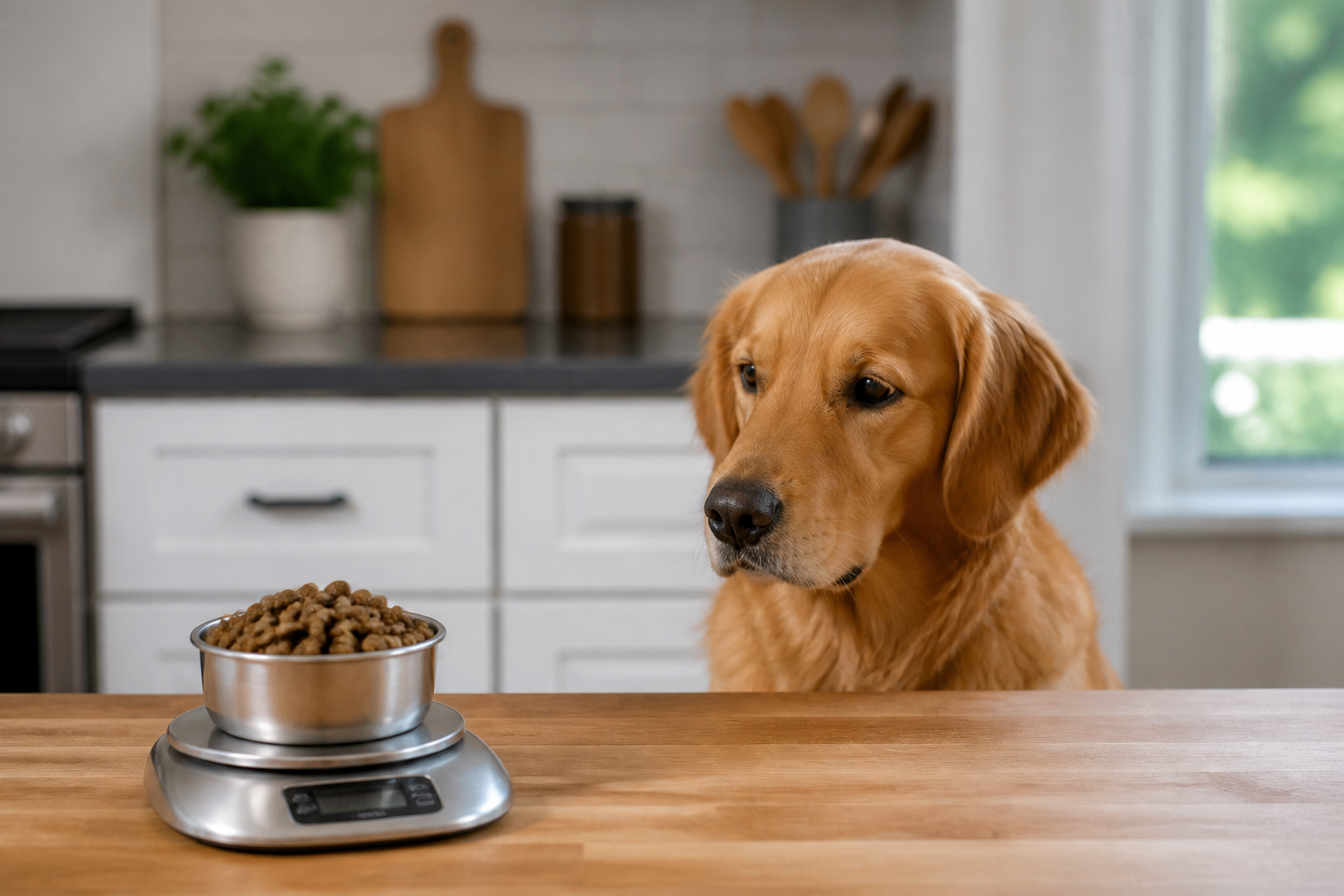
The best investment you can make for your dog's nutrition is a simple digital kitchen scale. They are inexpensive and easy to use. Instead of digging for a plastic scoop, you simply place the bowl on the scale and pour the food.
Step 1: Place your dog's empty bowl on the digital scale.
Step 2: Press the "tare" or "zero" button to subtract the weight of the bowl.
Step 3: Ensure the scale is set to grams.
Step 4: Pour the food until you hit the target weight.
This method is faster than using a measuring cup. It also means fewer dishes to wash. You do not have to worry about whether the cup is level or if the kibble is settled.
Read how many cups are in a 24-pound bag of dog food for another practical portioning example.
Comparing Popular Brands and Densities
To show how much weight can vary, let's look at the general differences between food types. We carry a wide range of brands with different processing methods.
| Food Type | Average Weight per Cup | Calorie Density |
|---|---|---|
| Standard Kibble | 95g - 115g | Moderate |
| Baked Kibble | 110g - 130g | High |
| Air-Dried Food | 140g - 160g | Very High |
| Freeze-Dried Raw | 40g - 60g | Low Weight, High Calorie |
As you can see, using the same "cup" for air-dried food and freeze-dried food would result in a massive feeding error. This is why we recommend checking the weight every time you switch formulas or brands.
For a denser food option, browse our selection of Orijen products.
The Impact on Senior Dogs and Joint Health
For senior dogs, maintaining a lean body weight is vital. Extra weight puts pressure on aging joints. This can lead to decreased mobility and pain. When we talk to customers about joint supplements like Cosequin or Zesty Paws, we always mention weight management first.
If a senior dog is even two pounds overweight, it can change how they walk. By switching to measuring in grams, you ensure they aren't slowly gaining weight as they become less active. This precision helps keep them mobile for longer.
Bottom line: Accuracy in the kitchen translates to better mobility in the yard for your senior dog.
Learn more about choosing the right dog food for senior pets.
Prescription Diets and the BaxterBoo Pharmacy
Sometimes, a dog needs more than just portion control. If your dog has a medical condition like diabetes, kidney disease, or severe obesity, your vet may prescribe a specific therapeutic food. These foods are formulated with precise nutrient ratios that are different from standard over-the-counter options.
Our pharmacy provides access to these FDA-approved prescription diets through our partnership with Pet's Choice. Since these diets are part of a medical treatment plan, accuracy is even more critical. Your veterinarian will likely give you a feeding instruction in grams rather than cups. Using a scale ensures you are following the medical advice exactly.
Our pharmacy also carries flea, tick, and heartworm preventatives. Many of these medications are dosed by weight. If your dog's weight fluctuates because of inaccurate feeding, they might fall into a different dosage bracket. Keeping their weight stable with gram-based feeding makes preventative care much simpler.
Browse our pet pharmacy for prescription and preventative-care options.
Tips for Multi-Dog Households
If you have multiple dogs, the "cup" method is even riskier. It is easy to accidentally give the smaller dog the larger dog's portion. Or, one family member might scoop a "heaping" cup while another scoops a "level" cup.
- Write the gram amount on a sticky note and move it to the food container.
- Assign one person to be the "weight master" for the week.
- Use different colored bowls for each dog to prevent mix-ups.
- If one dog needs a prescription diet, store it in a separate area to avoid confusion.
How to Transition from Cups to Grams
If you have been using a cup and your dog is at a healthy weight, you can easily find your "custom" gram weight. Simply scoop your normal amount into the cup as you always do. Then, pour that scoop onto a scale. Do this three times and take the average. That is the gram weight your dog is currently thriving on.
If your vet has told you that your dog needs to lose weight, do not just guess. Ask the vet for a target calorie count per day. You can then use the kcal/kg on the bag to find the exact gram weight. This removes the guesswork and helps the weight come off safely.
Key Takeaway: Transitioning to grams doesn't mean changing how much you feed, just how you measure it. It provides a baseline that you can adjust with total confidence.
For a broader look at converting dry-food measurements, read how much wet dog food equals one cup of dry.
Practical Steps for Success
- Buy a Digital Scale: Look for one with a "tare" function and a clear gram display.
- Locate the kcal/kg: Find this on your current bag of food.
- Check the BaxterBoo Website: We list nutritional information for many of the 500+ brands we carry.
- Mark the Container: Use a permanent marker on your food storage bin to write the grams per meal.
- Consult Your Vet: Always talk to a professional before making major changes to a dog's caloric intake.
Conclusion
Measuring your dog's food in grams is the most reliable way to support their long-term health. While a cup is a convenient tool, it is too inconsistent for a precise diet. By using a digital scale, you eliminate the risks of overfeeding and obesity. This small change in your daily routine can lead to more energy, better joint health, and a longer life for your pet.
We are here to help you find the best tools and nutrition for your dog's specific needs. Whether you are looking for premium kibble from Orijen or need a prescription diet from our pharmacy, we have you covered.
- Switching to grams prevents accidental overfeeding.
- Different kibble shapes change how much fits in a volume cup.
- A digital scale is faster and more accurate than a scoop.
- Prescription diets require the highest level of measurement precision.
Bottom line: Stop guessing with scoops and start weighing for a healthier dog.
FAQ
Why does my dog food bag only give measurements in cups?
Most manufacturers use cups because it is the most common tool in American kitchens. However, if you look closely at the nutritional panel, you will almost always find the kcal/kg or grams per cup listed in smaller print. If it is not there, the company's customer service can provide the weight of a standard cup for that formula.
Is a "cup" of dog food the same as a "cup" in a baking recipe?
In theory, yes, a standard US measuring cup is 8 fluid ounces. However, many pet owners use random scoops, coffee mugs, or plastic stadium cups that are much larger. Even when using a real measuring cup, the way the kibble settles means you are rarely getting the exact same weight twice.
How do I know if I am feeding the right amount of grams?
The best way to tell is by looking at your dog's body condition. You should be able to feel their ribs easily without a thick layer of fat, and they should have a visible waist when viewed from above. If they are losing or gaining weight unexpectedly while you are measuring in grams, it is time to consult your veterinarian.
Can I just use a marked scoop instead of a scale?
A marked scoop is better than a random cup, but it still relies on volume. The density of the food can change from the top of the bag to the bottom as the pieces settle or break. A scale measures the actual mass of the food, which is the only way to guarantee the calorie count is the same every single time.






