
 Save 15% on your 1st Autoship learn more

 Email us
 Live Chat
 FAQs
FAQs





Introduction
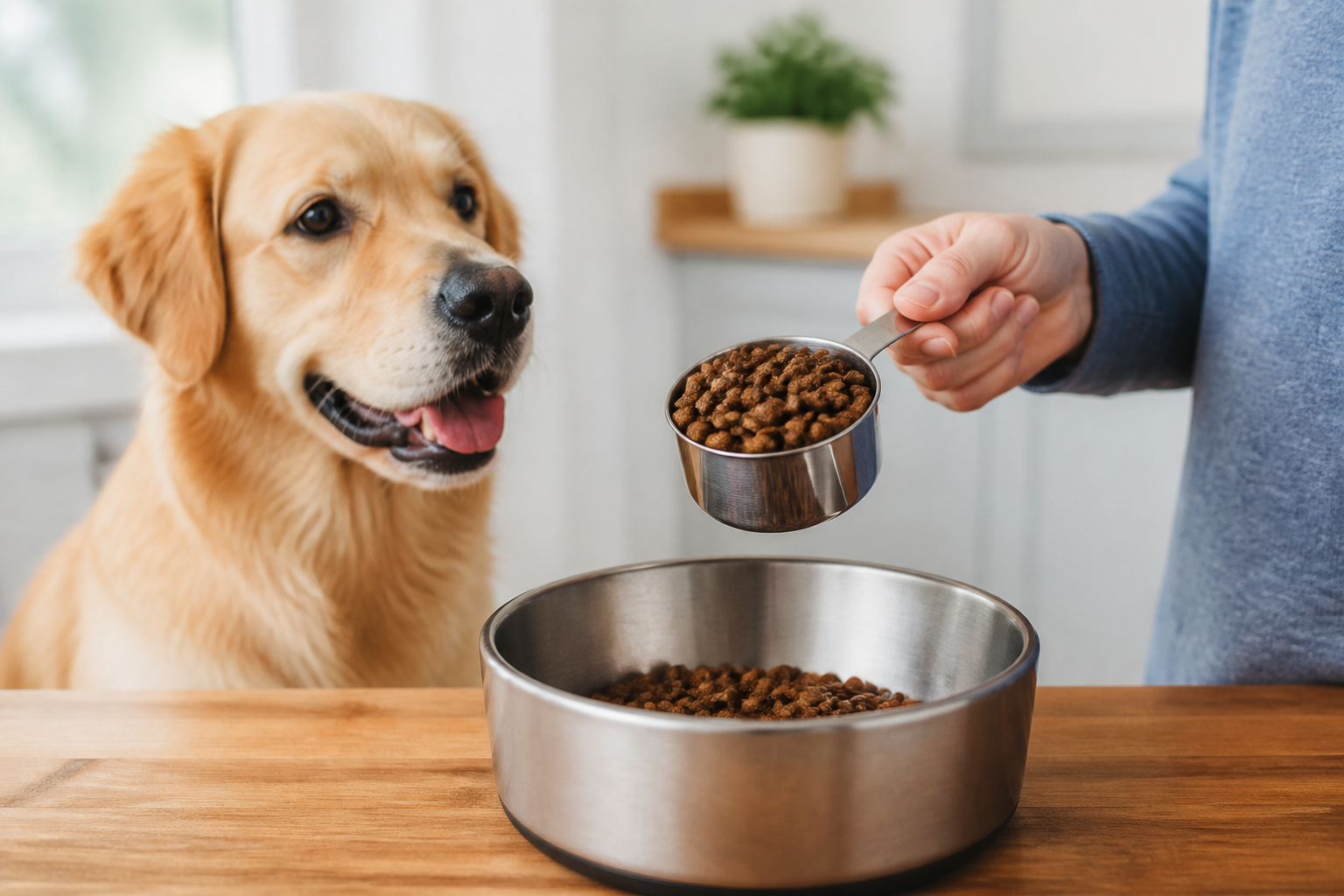
You stand over a fresh bag of kibble with a plastic scoop in hand. The feeding chart on the back of the bag suggests two cups per day for a dog of your pet's size. You grab a standard measuring cup from the kitchen and level it off. It seems simple enough. However, you might be surprised to learn that a cup is rarely just a cup when it comes to pet nutrition.
At BaxterBoo, we know that accurate feeding is the foundation of a long and healthy life. Most pet owners use volume to measure meals, but volume is notoriously unreliable for dry goods. This guide will help you understand the difference between fluid ounces and dry weight. We will explain why kibble density matters and how to ensure your dog gets exactly what they need. Learning to measure by weight can prevent common issues like obesity and nutrient deficiencies.
Quick Answer: A standard 8 ounce measuring cup typically holds between 3 and 5 ounces of dry dog food by weight. This variation happens because different kibble shapes and sizes create varying amounts of air space in the cup.
The Confusion Between Volume and Weight
The most common mistake in the dog food aisle is confusing fluid ounces with weight ounces. In the United States, we use the term ounce for two very different things. A fluid ounce is a measure of volume, or how much space something takes up. An ounce of weight is a measure of mass.
When you see an 8 ounce measuring cup in your kitchen, that 8 ounces refers to liquid. If you fill that cup with water, it weighs exactly 8 ounces. If you fill it with lead shot, it will weigh several pounds. If you fill it with popcorn, it might only weigh an ounce.
Dry dog food falls somewhere in the middle. Most kibble is relatively light and porous. Because it is a solid object with a specific shape, it does not pack perfectly into a cup. There are gaps of air between the nuggets. This means a cup of dog food almost never weighs 8 ounces.
Why Your Kitchen Cups Might Fail You
Many pet owners use random containers for scooping. You might use an old coffee mug, a plastic stadium cup, or a scoop provided by a different brand. Even if you use a real kitchen measuring cup, you face a challenge. Liquid measuring cups, like the glass ones with a spout, are designed to be read at eye level with fluid. Dry measuring cups are meant to be leveled off with a flat edge.
A study from the University of Guelph found that dog owners are often inaccurate when measuring kibble. Some participants in the study overfed by as much as 152 percent. Others underfed by nearly half. Using a 2 cup liquid measuring cup was found to be the most inaccurate method. The most reliable volume measurement came from using a 1 cup dry ingredient scoop for a 1 cup portion.
The Impact of Kibble Shape and Size
The physical design of the food changes how many ounces fit into a cup. Imagine a cup filled with large, round biscuits. There will be huge gaps of air between those biscuits. Now imagine a cup filled with tiny, pea-sized kibble. The smaller pieces nestle together much more tightly.
- Large Breed Formulas: These often have massive, crunchy pieces that take up a lot of volume but leave lots of air in the cup.
- Small Breed Formulas: Tiny kibble packs densely, meaning a cup of small breed food often weighs more than a cup of large breed food.
- Air-Dried or Dehydrated Food: Brands like Ziwi Peak or The Honest Kitchen are extremely dense. A small scoop of these foods can contain more weight and calories than a much larger scoop of traditional puffed kibble.
Key Takeaway: An 8 ounce volume cup measures how much space the food takes up, not how much the food actually weighs. To be truly accurate, you must look at the weight in grams or ounces provided by the manufacturer.
How to Read Your Pet Food Label Correctly
To solve the mystery of the cup, you have to look at the fine print on your dog food bag. The Association of American Feed Control Officials (AAFCO) requires specific information on labels. Most brands provide a calorie statement. This usually looks like a number followed by kcal/kg (kilocalories per kilogram) and kcal/cup.
For example, a bag might say it contains 3,500 kcal/kg and 400 kcal/cup. This tells you exactly how much energy is in a specific volume. However, the weight of that cup is still the missing link for many. If the bag says a cup is 400 calories, and you are using a scoop that is slightly larger than a standard cup, you are overfeeding every single day.
Calculating Weight from Calories
If you want to find out how many ounces are in your specific brand's cup, you can do a little math. You will need the kcal/kg and the kcal/cup from the label. For additional guidance, read our dry dog food measurement guide.
- Find the calories per kilogram (e.g., 3,600 kcal/kg).
- Find the calories per cup (e.g., 450 kcal/cup).
- Divide the calories per cup by the calories per kilogram (450 / 3,600 = 0.125).
- Multiply that result by 1,000 to get grams per cup (0.125 x 1,000 = 125 grams).
- Convert grams to ounces by dividing by 28.35 (125 / 28.35 = 4.4 ounces).
In this example, one cup of this specific food weighs 4.4 ounces. If you were assuming it weighed 8 ounces because of the cup size, you would be significantly off in your calculations.
The Density Factor
Density refers to how much mass is packed into a given space. Some premium brands we carry, like Orijen or Acana, are very nutrient-dense. They often weigh more per cup than budget brands that use more fillers and air. High-protein, high-fat diets are generally heavier. When you switch brands, you cannot assume the measurement stays the same. Even if both bags say to feed one cup, the actual weight of that cup will differ. You can compare options in our dry dog food category.
Vet Tip: If your dog is struggling with weight gain or sudden weight loss, stop measuring by volume immediately. Consult your veterinarian to determine your dog's Daily Energy Requirement (DER). Once you have a calorie goal, weigh the food on a digital scale to ensure you are meeting that goal exactly.
The Dangers of Overfeeding and Underfeeding
Accuracy is not just about being tidy in the kitchen. It is a health necessity. Pet obesity is a growing epidemic in the United States. Even an extra 10 percent of calories every day can lead to significant weight gain over a year. For a small dog, an extra ounce of food is a huge percentage of their daily intake.
Health Risks of Excess Weight
When a dog carries extra weight, every system in their body is stressed. Joint health is often the first thing to suffer. Extra pounds put pressure on the hips and knees, leading to arthritis and mobility issues. Obesity is also linked to heart disease, respiratory problems, and a shortened lifespan.
If your dog requires a specialized diet for weight management, we partner with Pet's Choice to provide a full pet pharmacy for dogs. This includes access to prescription diets like Farmina Vet Life, which are formulated for specific health conditions. These diets work best when the portions are strictly controlled by weight.
Risks of Underfeeding
While overfeeding is more common, underfeeding is also a risk when measurements are wrong. If a food is much lighter than you realize, your dog may not be getting enough nutrients. This can lead to a dull coat, lethargy, and a weakened immune system. Puppies and senior dogs are especially sensitive to these fluctuations. A growing puppy needs a very specific balance of calcium and phosphorus. If they get too little food because the kibble is less dense than expected, their bone development could be affected.
Bottom line: Inaccurate measuring is a primary driver of pet weight issues, making a digital food scale a vital tool for any pet owner.
Transitioning to Weighing Your Dog Food
If you are ready to ditch the plastic scoop and start weighing, the process is very simple. You do not need expensive equipment. A basic digital kitchen scale that measures in grams and ounces is perfect.
Step-by-Step: How to Weigh Meals
Step 1: Determine the weight needed.
Check your dog food bag for the weight of a serving in grams. If it only lists cups, use the manufacturer's website or call their customer service to ask for the weight of one cup in grams.
Step 2: Set up your scale.
Place your dog's empty bowl on the scale. Press the tare or zero button. This subtracts the weight of the bowl so you are only measuring the food.
Step 3: Pour the kibble.
Slowly pour the dry food into the bowl until the scale hits the target number.
Step 4: Note the volume for reference.
If you must use a scoop occasionally, look at where that weight falls in your scoop. This gives you a visual backup, though it will never be as accurate as the scale itself.
Why Grams Are Better Than Ounces
While our keyword focus is on ounces, most experts recommend using grams for the actual weighing process. Grams are a much smaller unit of measurement. This allows for finer precision. If your dog needs 4.2 ounces, it is easy to accidentally round to 4 or 4.5. If they need 119 grams, the scale gives you that exact number. For small dogs or cats, this level of detail is a game changer for health management.
Helpful Conversion Reference
| Food Type | Typical Weight per Cup (Ounces) | Typical Weight per Cup (Grams) |
|---|---|---|
| Standard Kibble | 3.5 to 4.0 oz | 100 to 113 g |
| Dense/Small Kibble | 4.0 to 4.5 oz | 113 to 128 g |
| Large/Airy Kibble | 3.0 to 3.5 oz | 85 to 100 g |
| Air-Dried Food | 4.5 to 5.0 oz | 128 to 142 g |
When to Adjust Your Dog's Intake
Even if you measure perfectly, your dog's needs will change over time. No feeding chart is a perfect rule for every animal. These charts are starting points based on average activity levels.
Life Stage Changes
Puppies need more calories per pound of body weight than adults. As they grow and their metabolism slows, you will need to adjust the weight of their meals. Senior dogs often become less active. Their bodies also become less efficient at processing certain nutrients. You may find that the weight of food that kept them fit at age five makes them gain weight at age ten.
Activity Levels
A dog that hikes five miles every weekend has different needs than a dog that primarily hangs out on the couch. If your lifestyle changes, their food weight should change too. During the winter, some dogs move less and may need a slight reduction in portion weight. Working dogs or those competing in agility may need a significant increase.
Monitoring Body Condition
Instead of just looking at the scale, look at your dog. You should be able to feel their ribs easily without a thick layer of fat over them. When looking from above, they should have a visible waistline. If you notice these physical markers changing, it is time to recalibrate how many ounces you are putting in the bowl. For more weight-management guidance, read our practical pet weight management guide.
Key Takeaway: The feeding guide on the bag is an estimate. Your dog's unique metabolism and lifestyle are the ultimate guides for how many ounces they should eat.
Beyond Kibble: Treats and Add-ins
If you are carefully weighing your dog's dry food but still seeing weight gain, look at the treats. Many owners forget that treats have calories too. A single large biscuit can have 100 calories or more. For a 20 pound dog, that could be 20 percent of their daily needs. Browse our dog treats when you need options for training or rewarding your pet.
The 10 Percent Rule
Veterinarians generally recommend that treats make up no more than 10 percent of a dog's total daily calories. If you give a high-value treat during training, you should subtract the equivalent weight of kibble from their next meal.
At BaxterBoo, we carry a wide variety of healthy treats, but even the best treats add up. If you use toppers, like wet food or fresh mix-ins, you must account for that weight as well. Use the same digital scale to weigh out toppers. This ensures the total daily "ounces" remain within a healthy range.
Pharmacy and Supplements
For dogs with specific health needs, supplements are often a part of the daily routine. Whether it is joint support or skin health, these are vital. However, some supplements are delivered in a chew format that contains calories. While small, these should be considered if you are managing a very strict weight loss plan. If your vet prescribes a medication or a specific therapeutic diet through our pharmacy partnership with Pet's Choice, ask them for the specific calorie count to ensure your math stays accurate. For meal add-ins, explore our dog food toppers.
Consistency Is Key
The biggest benefit of weighing your food is consistency. When multiple people in a household feed the dog, everyone scoops differently. One person might do a level cup, while another does a heaping scoop. This leads to a roller coaster of caloric intake.
Training the Household
Make sure everyone knows the weight goal for the meal. If you have a digital scale, leave a small sticky note nearby with the target number in grams. This removes all guesswork. It also makes it easier for pet sitters or family members to care for the dog properly while you are away.
Using Autoship for Convenience
Once you know exactly how many ounces your dog eats per day, you can predict exactly when you will run out of food. This makes our Autoship programme even more useful. You can calculate the total ounces in a bag, divide by your dog's daily portion weight, and set your delivery schedule to the exact day you need a refill. This saves you money and ensures you never have to rush to the store for a last-minute bag.
Bottom line: Weighing your dog's food eliminates the variables of human error and kibble density, providing the most reliable path to long-term health.
Conclusion
Understanding how many ounces are in a cup of dry dog food is the first step toward better pet parenting. While a kitchen cup measures volume, the scale measures the actual nutrition your dog receives. Remember that most kibble weighs between 3 and 5 ounces per cup, but this varies by brand and formula.
- Use a digital scale for the most accurate portions.
- Check the bag for kcal/kg to calculate the weight of your specific food.
- Adjust portions based on your dog's body condition and activity level.
- Account for treats and toppers in the daily total.
Feeding your dog shouldn't be a guessing game. By switching to weight-based measurements, you are taking a proactive step in preventing obesity and supporting their overall wellness. For those managing chronic health conditions or weight issues, our pharmacy offers a wide range of prescription diets and medications through our partnership with Pet's Choice. You can also earn rewards on every bag of food through the MVP Rewards programme, making it easier to provide the high-quality nutrition your dog deserves.
FAQ
Is 8 ounces of dry dog food the same as one cup?
No, 8 ounces of weight is not the same as a 1 cup volume measurement for dry food. A standard cup usually holds between 3 and 5 ounces of kibble by weight because dry food is less dense than water. To get exactly 8 ounces of weight, you would likely need to measure out nearly two full cups of most kibble brands.
Why does the weight of a cup of dog food change between brands?
The weight changes because of kibble density, size, and shape. Small, round kibble packs tightly with less air, making it heavier per cup. Large, irregularly shaped nuggets create more air pockets, making the cup lighter. Premium foods with high protein and fat levels are also typically heavier than budget foods with more air-puffed fillers.
Do I really need a scale to measure my dog's food?
While you can use a scoop, a scale is much more accurate and is highly recommended by veterinarians. Research shows that humans are very poor at estimating volume, often overfeeding by significant margins. A digital scale ensures that your dog gets the exact same amount of calories every day, which is essential for maintaining a healthy weight. For more context, see how much a cup of dry dog food weighs.
How do I find out how many grams are in a cup of my dog's food?
The easiest way is to look for the calorie statement on the back of the bag, which often lists grams per cup. If it is not there, you can calculate it using the kcal/kg and kcal/cup numbers. You can also contact the manufacturer directly or check their official website for the technical specifications of the formula.






